Here is the Muir Glacier and Inlet in Alaska.
The black-and-white picture is from Sept. 2, 1892. Guess when the color photo is from.
Aug. 11, 2005.
Below, the black-and-white photo of the Muir Glacier and Inlet is from the 1880s or '90s.
The color photo? Aug. 11, 2005.
Here's a slo-mo of another shot of the Muir Glacier from 1899 to 2003.
And again the Muir Glacier from 1899...... to 2003.
Don't these all now look like summery destinations!?!
Oh wait. These are GLACIERS? In Alaska?
Yeah. :(
Let's play a little choose your own adventure.
Adventure A :
What happens if we, the Earthlings of Earth, do nothing?
Let's suppose that climate change is either happening or not actually happening (despite overwhelming scientific consensus, BTW).
1. If climate change is not really happening ... we're fine. (Even though there is overwhelming scientific consensus that it IS happening, so it might seem a little silly for us to think that it's not happening ... but we're doing a thought experiment!)
2. If climate change is actually happening and we do NOTHING ... we have economic, social, political, environmental, and health catastrophes the likes of which have never been seen on Earth. :( Basically, the world as we know it is dunzo.
Adventure A's choices: We bet against overwhelming scientific consensus in the hopes that overwhelming scientific consensus is wrong ... or we suffer economic, social, political, environmental, and health catastrophes the likes of which have never been seen on Earth. Not to be all tree-hugger here, but it's kind of a no-brainer for me.
We do not choose this adventure!!!
Adventure B :
What happens if we, the Earthlings of Earth, take action?
1. If climate change is not really happening ... we'll have spent lots of money investing in clean energy that has been proven to create tons of jobs. It might strain our economy, but there will be more jobs because we'll be investing in new industries. So we'll have more jobs and the air will at least be nicer.
2. If climate change is actually happening ... we'll have spent money in exactly the right place, breathing will be awesome, people will have jobs, and we'll be fine. It's a simple adventure because it's simple. Doing something about climate change simply prepares the world for easy livin'.
I CHOOSE ADVENTURE B2!!!
The way I see it, there's a choice to invest money in not having a catastrophe + jobs and happy people, or there's a choice to roll the dice on catastrophe, not invest in jobs, and make it harder to breathe.
What's your choice?
I know mine. It's so. so. SO. clear.
Thanks to this magical YouTube video by wonderingmind42 for the action-versus-no-action on global climate change inspiration.
Aunt Jeannie , we asked daddy to post this for us , Jenny says she know what adventure you will choose because you started mama on her adventure .
Aunt Jeannie hope you had a good Valentine Day , we had a good one , Daddy took mama out dancing and a little gambling . We love you very much and hope you are getting better .
This post is from all the cubs .
Wrote by Sha .
This post was written by concerned , die hard environmentalists, who are trying to save the planet we abused so badly....none of whom are old enough to drive. That makes me feel ashamed of my generation. How about you??
Gravity, in the form of gravitational waves, is on a lot of people's minds at the moment. We have all experienced the force of gravity. It is what happens to you when you jump up into the air. Disappointingly for anyone with ambitions to be Supergirl or Superman, we tend to fall right back down to the ground. But what if we could switch gravity off?
Physics is adamant that this could never actually happen. But that has not stopped people exploring the idea. Here, based on the collective wisdom of several experts, is the best guess at what would happen to you if gravity suddenly vanished.
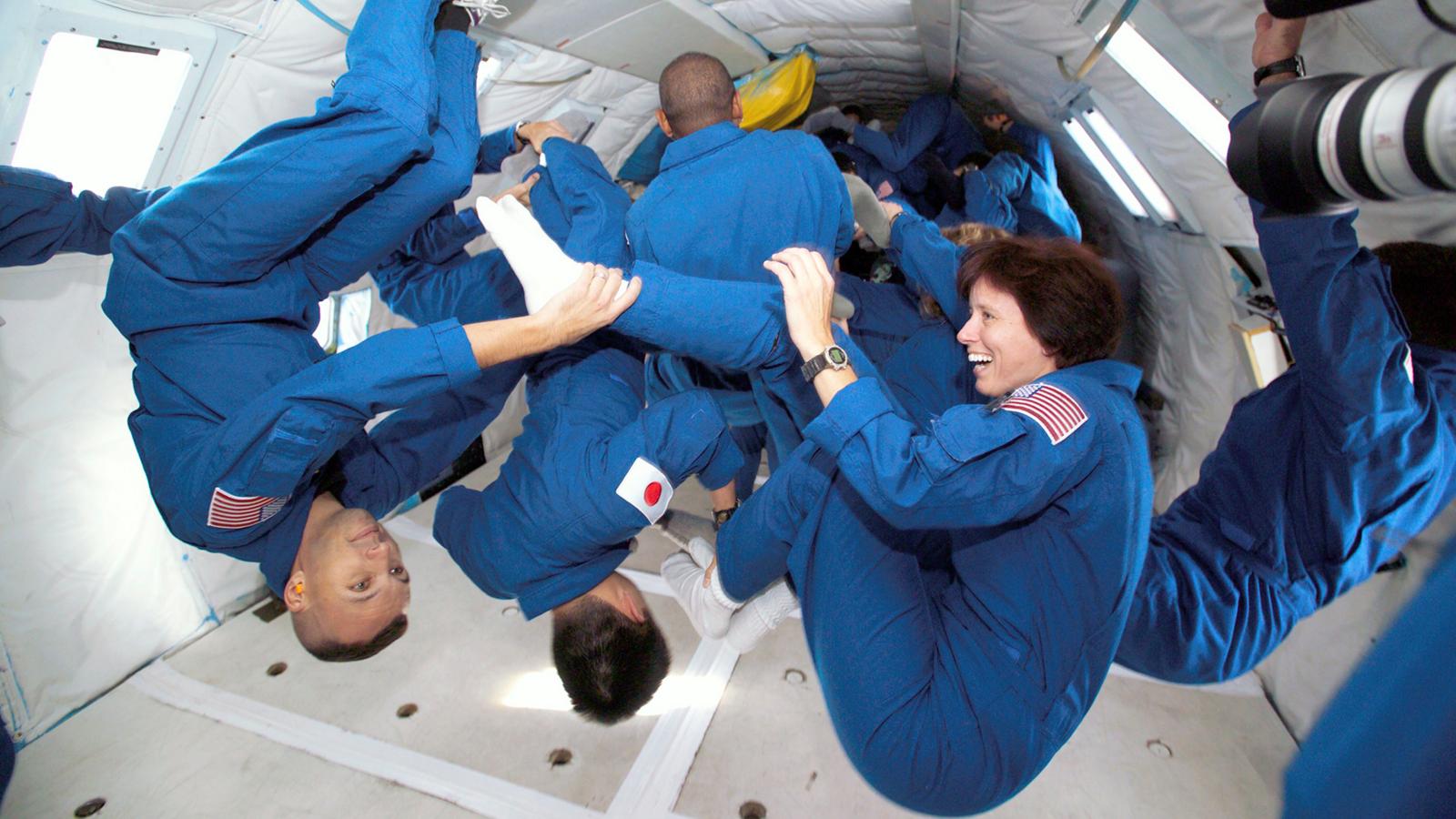
Jay Buckey, a physician and one-time NASA astronaut, explored how the absence of gravity affects the human body in a short Ted-Ed lecture. Wounds take longer to heal and the immune system loses its strength
Buckey says that our bodies are adapted to an Earth-like gravitational environment. If we spend time living where gravity is different, such as on board a space station, our bodies change.
It is now an established fact that astronauts lose bone mass and muscle strength during stints in space, and their sense of balance changes.
An absence of gravity brings other problems. For reasons not entirely clear, our red blood cell count falls, bringing on a form of "space anaemia". Wounds take longer to heal and the immune system loses its strength. Even sleep is disturbed if gravity is weak or absent.
That is just what happens after a short visit to space. "What if you were to grow up without gravity?" Buckey asks. "What about the systems that depend on gravity like your muscles, or your balance system, or your heart and blood vessels?"
There is good reason to believe the human body would develop differently.
Living in zero gravity affects your body (Credit: NASA/Science Photo Library)
Buckey points to an experiment in which a cat grew up with one eye permanently hidden behind an eyepatch. The cat was rendered blind in the eye as a result. The circuitry that would have connected it to the brain's vision processing regions failed to develop, because the eye was not processing any visual information: a very literal example of the old phrase "use it or lose it".
Earth's atmosphere and its oceans, rivers and lakes would be one of the first things to drift away into space. It seems likely that the rest of our bodies would respond similarly. If gravity was not around for our hearts, muscles and bones to respond to, our organs would almost certainly develop in different ways. That said, if gravity did get switched off we would have more pressing things to worry about than the long-term effects on human development.
Scientists have explored the immediate physical consequences of losing gravity. The first problem is that Earth is rotating at high speed, rather like the way a weight on a string rotates if you spin it around your head. Switching off' gravity is analogous to letting go of the string. Things not attached to the Earth in any other way would fly off into space in a straight line that would take them away from the surface of the Earth.
Staying inside offers a measure of protection. Anyone unfortunate enough to be outside at the time would quickly be lost. People inside buildings would be safer, because most buildings are so firmly rooted to the ground that they would stay put even without gravity – at least for a while. Anything else not nailed down would also float off. Earth's atmosphere and its oceans, rivers and lakes would be one of the first things to drift away into space. Eventually there would be no clumps of matter, like stars or planets, anywhere in the Universe. Oh, and of course we'd all die.
A lack of gravity would eventually take its toll on our very planet. Earth itself would most likely break apart into chunks and float off into space.
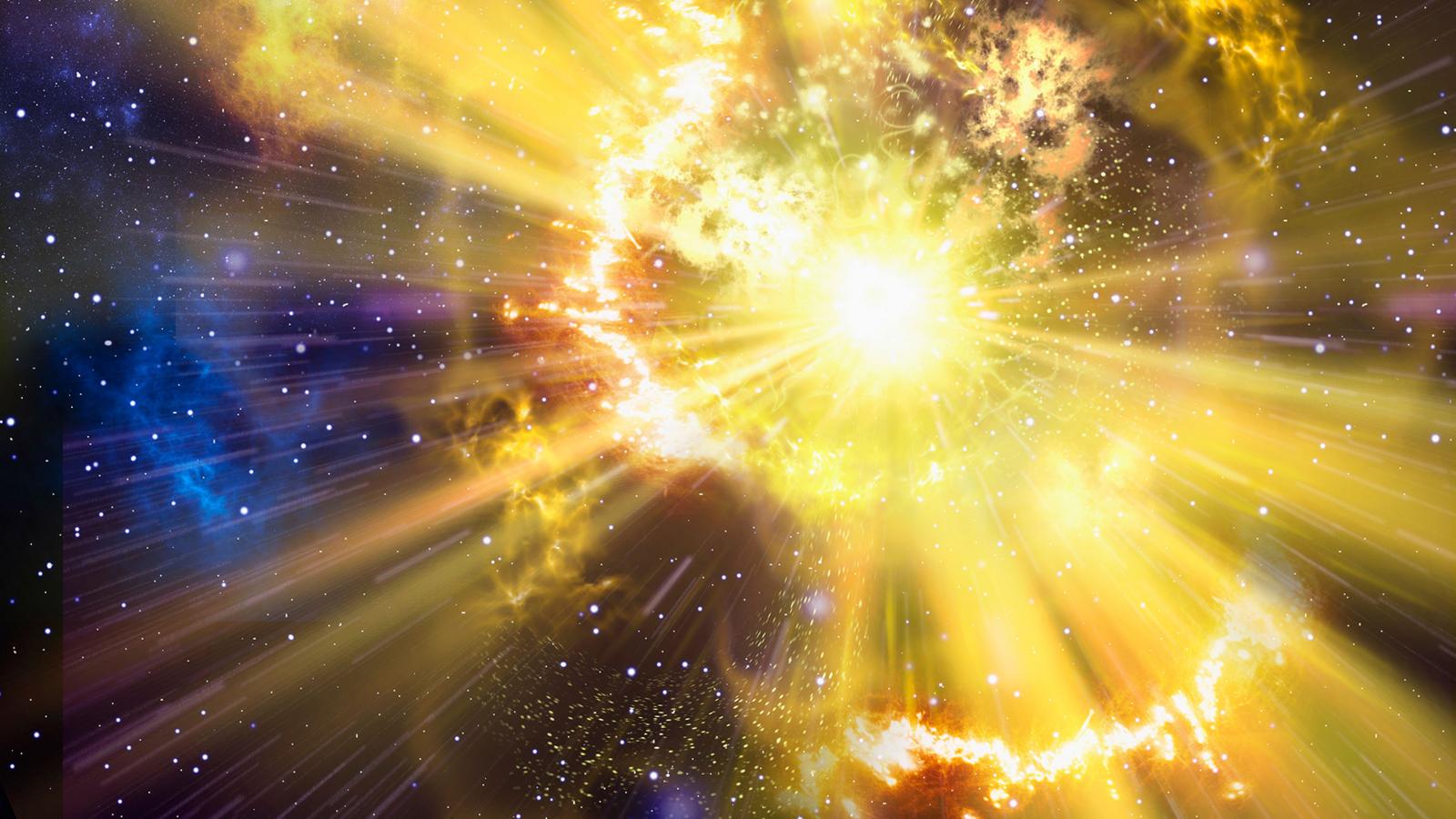
A similar fate would befall the Sun. Without the force of gravity to hold it together, the intense pressures at its core would cause it to burst open in a titanic explosion. The same thing would happen to all the other stars in the Universe. However, because they are so far away, it would be years before the light from their death throes reached you.
Eventually there would be no clumps of matter, like stars or planets, anywhere in the Universe. There would just be a diffuse soup of atoms and molecules, drifting around not doing anything much.
This hasn't ended terribly well
This scenario – which just to repeat, could never happen – illustrates just how fundamental gravity is to the workings of the Universe. Without it, nothing interesting like planets could ever exist. Oh, and of course we'd all die.
Gravity is one of four fundamental forces that govern our Universe. The other three are just as crucial. Without electromagnetism and the strong and weak nuclear forces, atoms themselves would fall apart. But gravity is the only one that is truly a household name, which is perhaps why we are so fascinated by ideas like antigravity – and why the discovery of gravitational waves is so exciting, even if it never touches any of our lives directly.... we know it is making the universe work and holds it all together.
The Zika virus, carried by the Aedes aegypti mosquito, and suspected of being the cause of thousands of birth deformities in Brazil, has now been linked to cases of paralysis .
The disease has moved north to Colombia, and although it is suspected of causing a specific kind of creeping paralysis, studies have not conclusively proved it. But dozens of reports from doctors and patients are mounting evidence that it is probably so.
Edgar Latulip of Waterloo went missing 30 years ago and was presumed dead, but it turns out it was only his memories that vanished. Edgar Latulip was reported missing in 1986 from Waterloo region, Niagara Regional Police say. Edgar Latulip was 21 when he took a bus to the Niagara region, where he suffered a head injury that robbed him of much of his memory, Const. Phil Gavin said. Latulip went on to live in the area for the next 30 years, but recently began having memory flashes that made him believe he was living under the wrong name. In January, Latulip revealed suspicions of his past identity to a social worker, who did a search online and discovered that he was the subject of a long-standing missing person’s investigation. Det.-Const. Duane Gingerich, one of the Waterloo Regional Police officers who investigated Latulip’s disappearance, is thrilled to close the case. A reported sighting in Hamilton in 1993 gave him hope that Latulip might still be alive, but he knew the odds of a happy ending were slim. “I had hopes that he was out there somewhere,” he said. “For us as investigators, this is great, this is awesome. It’s satisfying because most of these cases don’t turn out this way. You expect the worst when a person is missing for that period of time.” “It was only recently that these lapses in his memory started to come back,” Gingerich said. “There was enough about it that we thought, ‘There’s something to this.’ ” In January, Latulip came to the St. Catharines police station and provided a voluntary DNA sample. This week, it was revealed that sample matched a family member’s DNA on file with the Waterloo Regional Police. If he wants to meet his family, he’ll get that chance. “He’s been informed that match is there and now we’re working toward reunification with his family in the near future,” Gavin said. Latulip’s mother could not be reached for this story. But police say they want to help her see her son again. In the meantime, there are so many questions about what happened to Latulip after he went missing all those years ago. He told police he left Kitchener by bus after he left his group home. At the time, investigators suspected he might have gone to the falls to end his life and his body had simply never been recovered. “I think he got on a bus, and the bus took him to Niagara Falls, and then he wandered on to St. Catharines. That’s when he suffered the head injury. When he kind of woke up, things were a lot different,” Gavin said. “This is a new one for me. I’ve never seen anything like this before.” In a 2014 interview, his mother said her son’s disappearance left a painful hole in her life that couldn’t be healed. “This is always at the back of my mind. Having an answer would mean closure,” she said at the time. “When Edgar disappeared, I became quite sick. I had to take a leave of absence from work. I was near a nervous breakdown.” Latulip spoke to a social worker Jan. 7 On Jan. 7, Latulip met with a social worker and told her he thought he was somebody else, Gavin said. The social worker found his missing persons case file and police were then called in. Latulip volunteered to have a DNA test done and on Monday, the results came back indicating he was Latulip. Gavin said it is an unusual, but happy resolution to the case. "When someone goes missing for an extended period of time, they don't want to be found and they're off the grid and we don't find them," Gavin said. "Or the other option, sadly, is sometimes people are deceased. I've never heard of something like this where someone's memory has come back and their identity is recovered. "It is absolutely a good news story," Gavin added. "I try not to only think about his mother's side, but also Mr. Latulip's side where for 30 years you've learned a certain way and someone tells you and confirms to you that's not who you are. That's a lot to take in, personally, right, so there's interesting pieces for him as well." 'Now it's up to him what happens' According to Holtom, who spoke with Latulip's mother on Wednesday, the missing man has yet to be reunited with her. "I'm sure [it's] very overwhelming for both of them, for his mom and himself, and I'm sure they're planning a reunion in the coming days," she told CBC News. "Now it's up to him what happens, and his family what happens from here, so we don't have any part of that. Our investigators, I know there were quite a few who handled the case, are glad to know he's OK."
Scientists are claiming a stunning discovery in their quest to fully understand gravity.
They have observed the warping of space-time generated by the collision of two black holes more than a billion light-years from Earth.
The international team says the first detection of these gravitational waves will usher in a new era for astronomy. It is the culmination of decades of searching and could ultimately offer a window on the Big Bang.
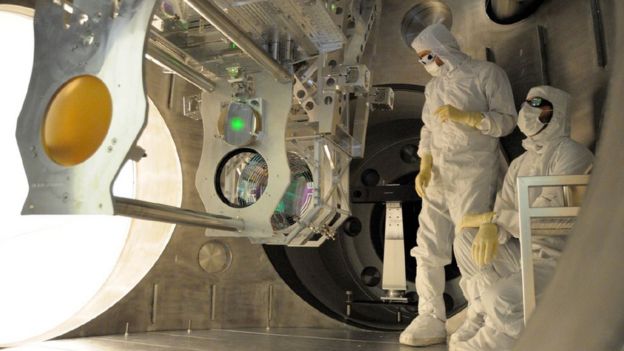
The research, by the LIGO Collaboration, was published today in the journal, Physical Review Letters. The collaboration operates a number of labs around the world that fire lasers through long tunnels, trying to sense ripples in the fabric of space-time.
Expected signals are extremely subtle, and disturb the machines, known as interferometers, by just fractions of the width of an atom.
But the black hole merger was picked up by two widely separated LIGO facilities in the US.The merger radiated three times the mass of the sun in pure gravitational energy.
"We have detected gravitational waves," Prof David Reitze, executive director of the LIGO project, told journalists at a news conference in Washington DC.
"It's the first time the Universe has spoken to us through gravitational waves. Up until now, we've been deaf."
The LIGO Collaboration fires lasers through long tunnels, trying to sense ripples in the fabric of space-time
Prof Karsten Danzmann, from the Max Planck Institute for Gravitational Physics and Leibniz University in Hannover, Germany, is a European leader on the collaboration.
He said the detection was one of the most important developments in science since the discovery of the Higgs particle, and on a par with the determination of the structure of DNA.
"There is a Nobel Prize in it - there is no doubt," he said. "It is the first ever direct detection of gravitational waves; it's the first ever direct detection of black holes and it is a confirmation of General Relativity because the property of these black holes agrees exactly with what Einstein predicted almost exactly 100 years ago."
Ripples in the fabric of space-time
Gravitational waves are prediction of the Theory of General Relativity
Their existence has been inferred by science but only now directly detected
They are ripples in the fabric of space and time produced by violent events
Accelerating masses will produce waves that propagate at the speed of light
Detectable sources ought to include merging black holes and neutron stars
LIGO fires lasers into long, L-shaped tunnels; the waves disturb the light
Detecting the waves opens up the Universe to completely new investigations
That view was reinforced by Prof Stephen Hawking, who is an expert on black holes. He said he believed that the detection marked a key moment in scientific history.
"Gravitational waves provide a completely new way at looking at the Universe. The ability to detect them has the potential to revolutionise astronomy. This discovery is the first detection of a black hole binary system and the first observation of black holes merging," he said. Apart from testing (Albert Einstein's theory of) General Relativity, we could hope to see black holes through the history of the Universe. We may even see relics of the very early Universe during the Big Bang at some of the most extreme energies possible."
Team member Prof Gabriela González, from Louisiana State University, said: "We have discovered gravitational waves from the merger of black holes. It's been a very long road, but this is just the beginning.
"Now that we have the detectors to see these systems, now that we know binary black holes are out there - we'll begin listening to the Universe. "
The LIGO laser interferometers in Hanford, in Washington, and Livingston, in Louisiana, were only recently refurbished and had just come back online when they sensed the signal from the collision. This occurred at 10.51 GMT on 14 September last year.
On a graph, the data looks like a symmetrical, wiggly line that gradually increases in height and then suddenly fades away.
"We found a beautiful signature of the merger of two black holes and it agrees exactly - fantastically - with the numerical solutions to Einstein equations... it looked too beautiful to be true," said Prof Danzmann.
Prof Sheila Rowan, who is one of the lead researchers involved in the project, said that the first detection of gravitational waves was just the start of a "terrifically exciting" journey.
"The fact that we are sitting here on Earth feeling the actual fabric of the Universe stretch and compress slightly due to the merger of black holes that occurred just over a billion years ago - I think that's phenomenal. It's amazing that when we first turned on our detectors, the Universe was ready and waiting to say 'hello'."
Being able to detect gravitational waves enables astronomers finally to probe what they call "dark" Universe - the majority part of the cosmos that is invisible to the light telescopes in use today.
Perfect probe
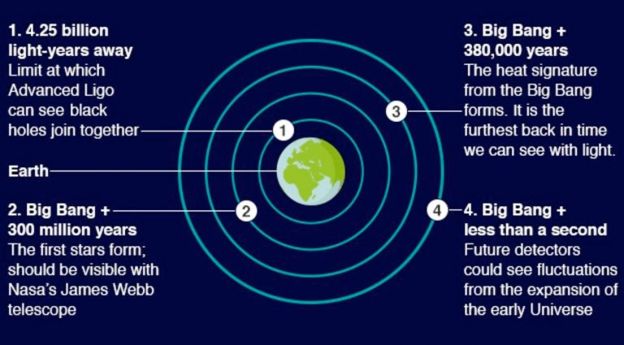
Not only will they be able to investigate black holes and strange objects known as neutron stars (giant suns that have collapsed to the size of cities), they should also be able to "look" much deeper into the Universe - and thus farther back in time. It may even be possible eventually to sense the moment of the Big Bang.
"Gravitational waves go through everything. They are hardly affected by what they pass through, and that means that they are perfect messengers," said Prof Bernard Schutz, from Cardiff University.
"The information carried on the gravitational wave is exactly the same as when the system sent it out; and that is unusual in astronomy. We can't see light from whole regions of our own galaxy because of the dust that is in the way, and we can't see the early part of the Big Bang because the Universe was opaque to light earlier than a certain time. With gravitational waves, we do expect eventually to see the Big Bang itself,"
In addition, the study of gravitational waves may ultimately help scientists in their quest to solve some of the biggest problems in physics, such as the unification of forces, linking quantum theory with gravity.
At the moment, General Relativity describes the cosmos on the largest scales tremendously well, but it is to quantum ideas that we resort when talking about the smallest interactions. Being able to study places in the Universe where gravity is really extreme, such as at black holes, may open a path to new, more complete thinking on these issues.
A laser is fed into the machine and its beam is split along two paths
The separate paths bounce back and forth between damped mirrors
Eventually, the two light parts are recombined and sent to a detector
Gravitational waves passing through the lab should disturb the set-up
Theory holds they should very subtly stretch and squeeze its space
This ought to show itself as a change in the lengths of the light arms (green)
The photodetector captures this signal in the recombined beam
Scientists have sought experimental evidence for gravitational waves for more than 40 years. Einstein himself actually thought a detection might be beyond the reach of technology.
His theory of General Relativity suggests that objects such as stars and planets can warp space around them - in the same way that a billiard ball creates a dip when placed on a thin, stretched, rubber sheet.
Gravity is a consequence of that distortion - objects will be attracted to the warped space in the same way that a pea will fall in to the dip created by the billiard ball.
Inspirational moment
Einstein predicted that if the gravity in an area was changed suddenly - by an exploding star, say - waves of gravitational energy would ripple across the Universe at light-speed, stretching and squeezing space as they travelled. Although a fantastically small effect, modern technology has now risen to the challenge.
Much of the R&D work for the Washington and Louisiana machines was done at Europe's smaller GEO600 interferometer in Hannover.
"I think it's phenomenal to be able to build an instrument capable of measuring [gravitational waves]," said Prof Rowan.
"It is hugely exciting for a whole generation of young people coming along, because these kinds of observations, and this real pushing back of the frontiers, is really what inspires a lot of young people to get into science and engineering."
Truly unbelievable!! Finally proof that the theory is fact.
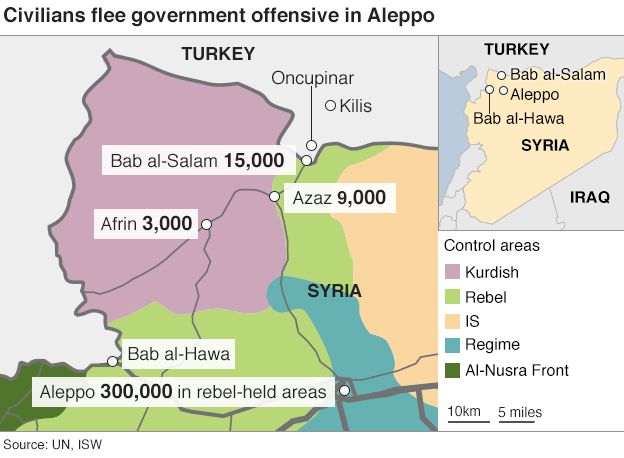
The announcement comes amid a new Syrian government offensive in Aleppo province
World powers have agreed to seek a nationwide "cessation of hostilities" in Syria to begin in a week's time, after talks in Germany. The halt will not apply to the battle against jihadist groups Islamic State (IS) and al-Nusra Front.
Ministers from the International Syria Support Group also agreed to accelerate and expand aid deliveries. The announcement comes as the Syrian army, backed by Russian air strikes, advances in Aleppo province. The move threatens to encircle tens of thousands of civilians in rebel-held parts of the major city of Aleppo.
US Secretary of State John Kerry admitted the ceasefire plan was "ambitious" and said the real test would be whether the parties honoured the commitments.
"What we have here are words on paper, what we need to see in the next few days are actions on the ground," he said.
A task force chaired by the US and Russia will work to implement the truce through consultations with Syria's warring factions. Aid deliveries for besieged Syrian communities are due to begin as early as Friday.
Mr Kerry made the announcement alongside his Russian counterpart Sergei Lavrov and the UN special envoy for Syria, Staffan de Mistura. Mr Lavrov said there were "reasons to hope we have done a great job today". An earlier proposal from Russia envisaged a truce starting on March 1st.At the press conference Mr Kerry again suggested that Russian strikes were targeting what the West sees as moderate opposition forces, rather than terrorists, as Moscow says. British Foreign Secretary Philip Hammond said the cessation would only work if Russia halted its raids, although Mr Lavrov said they would continue.
Of course Russia will continue with it's campaign of airstrikes. In my opinion, they want the Sunni rebels and Kurds to surrender, to completely concede defeat and knuckle under to Assad's rule. That is the only condition under which hostilities will cease. Then they will focus on Islamic State incursions.
The Support Group also agreed that peace talks involving the Syrian government and rebels should resume as soon as possible. Initial talks were suspended just days after they began earlier this month in Geneva, in the wake of the Aleppo offensive.
Thousands of people displaced by the fighting have been stranded at the border with Turkey and aid agencies have warned of a rapidly deteriorating humanitarian situation.
A spokesman for the Syrian opposition, Salem al-Meslet, stated, "if we see action and implementation on the ground, we will be soon in Geneva". The rebels do not believe the agreement is worth the paper it's written on. They don't trust Assad or Russia to stick to any agreed terms. The Aleppo Offensive, launched by the Syrian army and backed by Iran and Russia continued, unabated, while peace talks straggled to a halt during the last attempt at a truce.
Syria conflict - key questions
Why is there a war in Syria?
Anti-government protests developed into a civil war that, four years later, has ground to a stalemate, with the Assad government, Islamic State, an array of Syrian rebels and Kurdish fighters all holding territory.
Who is fighting whom?
Government forces concentrated in Damascus and the centre and west of Syria are fighting the jihadists of Islamic State and al-Nusra Front, as well as less numerous so-called "moderate" rebel groups, who are strongest in the north and east. These groups are also battling each other.
How has the world reacted?
Iran, Russia and Lebanon's Hezbollah movement are propping up the Alawite-led Assad government, while Turkey, Saudi Arabia and Qatar back the more moderate Sunni-dominated opposition, along with the US, UK and France. Hezbollah and Iran are believed to have troops and officers on the ground, while a Western-led coalition and Russia are carrying out air strikes.