Wednesday, March 16, 2016

Tully Fossil...300 million year old fish ancestor

Reconstruction of what the Tully Monster might have have looked like 300 million years ago

 Reconstruction of what the Tully Monster might have have looked like 300 million years ago  
              
Scientists say a worm-like fossil with mysterious origins is actually the ancestor of living fish. The 300 million-year-old animal was found at an Illinois mine in 1958 by fossil collector Francis Tully.  The "Tully monster" has been a puzzle to scientists ever since, and has been likened to worms and molluscs.
US researchers say the fossil is a backboned animal rather than an invertebrate as once thought, based on an analysis of 1,000 museum specimens. Their findings, published in Nature, place it firmly on the tree of life of vertebrates and related to fish such as lamprey and hagfish.
It has a rudimentary backbone, which has been misinterpreted in the past as a trace of gut, said Victoria McCoy of Yale University. That makes it one of the first vertebrates on Earth.
"The Tully Monster is very weird looking but we found it is related to modern lamprey".
"It shows us how evolution can take something very familiar and make it very weird without changing what we know about the tree of life."

What are lampreys?
  • Lampreys are the world's oldest living vertebrates, dating back to before the reign of the dinosaurs.
  • They are a very ancient and primitive group of jawless vertebrates, which appear to have changed little over time.
  • Most species of lamprey are parasites and have long, eel-like bodies.
  • They use their jawless mouths to stick to a host fish by suction before sucking out the living tissues.
Ancient landscape
Remains of the Tully monster (Tullimonstrum gregarium) have been found only in the Mazon Creek fossil beds of Illinois.
It once swam in the warm coastal waters of a 300 million year old ocean, alongside jellyfish, worms, and sea cucumbers.
The animal was soft-bodied making it particularly difficult to classify from traces of
the tissues that remain.


Picture of a fossil of the tully monster
A specimen showing the animal's eye bar, tail fin, and the proboscis and jaw folded back over the body


More views of Tully fossils

Dr McCoy and colleagues analyzed more than 1,200 museum specimens in order to find out where the animal belongs on the evolutionary tree. They say it was about 10 cm long, with a slender, segmented body, eyes projecting at each end of a long rigid bar, a tail fin, and jaws containing rows of teeth at the end of a proboscis.
The research was carried out by teams at Yale University, the American Museum of Natural History in New York, Field Museum of Natural History in Chicago and Yale Peabody Museum of Natural History.
This is a 300 million year old fossil of a species of Earth creature. Just imagine what other Earth species of that period must have looked like, very alien. One of them was our ancestor. It may be hard to envision, us evolving from a sea creature but it is the only possibility, since the earth was originally 100% covered with water. For doubters and sceptics ....  sea fossils have been found on mountain tops and in deserts. Once again, science trumps fairy tales.

Monday, March 14, 2016

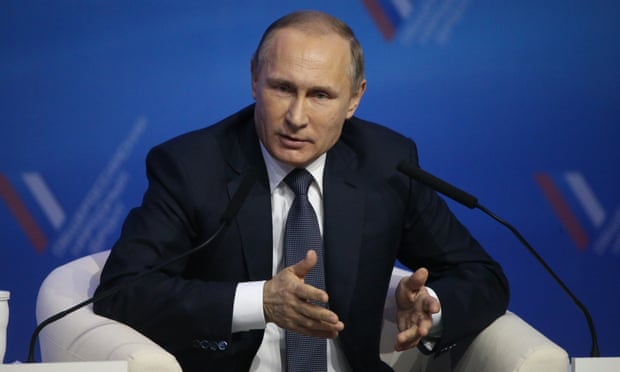
Putin pulls forces out of Syria...Surprise Maneuver


I am always interested in Putin's tactics, whether sneaky or bullying.  He is the one to watch because he is dangerous. He rarely keeps a promise or sticks to agreements he puts his name to.  He can tip the balance of world power. He loves to flex his military muscles in a threatening way because he knows the rest of the world (excluding the Middle East and North Korea) is striving for a peaceful co-existence and is very reluctant to initiate hostilities.  So, he pushes the envelope to see how far he can go. Then he seems to pull back at the very brink of an international incident. I think he especially enjoys yanking Obama's chain.

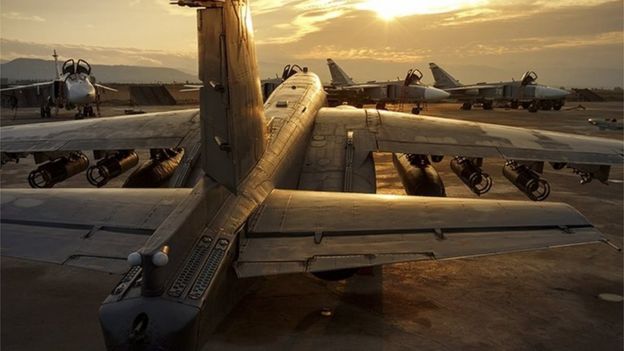
In a surprise move, Putin has ordered his military to start withdrawing the "main part" of its forces in Syria from Tuesday. He said the Russian intervention had largely achieved its objectives. What happened to his promise to stay and help defeat ISIS ? The comments come amid fresh peace talks in Geneva aimed at resolving the five-year Syrian conflict.
Russia is a key ally of Syrian President Bashar al-Assad, whose office said in a statement he had agreed to the move. The pullout was "in accordance with the situation on the ground", the statement said.
Russia began its campaign of air strikes in Syria last September, tipping the balance in favour of the Syrian government and allowing it to recapture territory from rebels.
"I consider the mission set for the defense ministry and the armed forces on the whole has been accomplished," Mr Putin said in a meeting at the Kremlin.
"I am therefore ordering the defense ministry to begin the withdrawal of the main part of our military force from the Syrian Arab Republic from tomorrow."

Putin may be hedging his bets:

When Russian airstrikes began in Syria, President Assad's regime was on the brink of collapse. Less than six months later, Russia says its action allowed Syrian government troops to retake 10,000 sq km (3,860 sq miles) of territory.
By intervening, Vladimir Putin made clear that Russia was prepared to assert its interests. The results ensure Moscow a bigger say in what happens at the peace talks.
The decision to scale down Russian operations may partly be fuelled by cost, given falling oil prices; it could also be driven by a desire to end Russia's isolation and western sanctions.
But while Vladimir Putin has ordered his foreign minister to focus efforts on the political front in Syria, he appears to be hedging his bets.
Critically, sophisticated air defence systems seem set to stay. And as we have never been told officially how many troops were ever sent to Syria, we are unlikely to know how many will remain.
Mr Putin said that Russia's Hmeimim air base in Latakia province and its Mediterranean naval base at Tartus would continue to operate as normal. He said both must be protected "from land, air and sea".

Syria's opposition cautiously welcomed the Russian announcement.
"If there is seriousness in implementing the withdrawal, it will give the [peace] talks a positive push," said Salim al-Muslat, spokesman for the opposition umbrella group, the High Negotiations Committee.
The US also gave a guarded response. US officials said Washington had received no advance warning of Mr Putin's statement.
"We will have to see exactly what Russia's intentions are," said White House spokesman Josh Earnest.
President Obama has discussed the development with Mr Putin in a phone call, the
White House and the Kremlin said, giving few details. It seems, there is suspicion and unease all around until Russia's motives become clearer.  No wonder there is little basis for trust. Russia has long insisted its bombing campaign only targets terrorist groups but Western powers have complained the raids hit political opponents of President Assad...Including hundreds of innocent citizens, hospitals and humanitarian aid stations.

What did Russia achieve in Syria?

*Russian aircraft flew more than 9,000 sorties
*Destroyed 209 oil production and transfer facilities
*Helped Syrian government troops to retake 400 settlements
*Helped Damascus to regain control over more than 10,000 sq km (3,860 sq miles) of   territory
Source: Russian Defence Minister Sergei Shoigu, quoted by Russian media.

The UN's envoy to Syria, Staffan de Mistura has meanwhile described the latest peace talks as a "moment of truth". He said there was no "plan B" should the talks fail, with the only alternative a return to war.
A cessation of hostilities agreed by most participants in the conflict began late last month - but there have been reports of some violations on all sides.

Mutated Giant Rat..What does that tell us about the future?


[How big could a rat possibly–oh wow that’s big/Sky News]

A massive rat, believed to be “bigger than a four-year-old boy” has been found by a group of gas workers in London. Engineer Tony Smith, 46, discovered the dead rat in a bush next to a children’s playground while working nearby.The large rodent measured four feet long.
“I’ve got a cat and Jack Russell and it was bigger than both of those,” Smith told said
His co-worker, James Green is pictured holding the giant rodent with an extendable claw just before they stuck it in the trash.
“We thought we had better take a picture or people won’t believe it’s real,” Smith told ITV News.
Smith explained that the estate where he was working had been infested with rats and the poison left around to catch the rodents wasn’t working since they’ve become immune over the years.
“The garbage bins get left open nearby so these little fellas have a pretty good diet,” Smith told the news outlet. 
Pest control experts have warned local residents that the rats are mutating and growing bigger as they feed on thrown-away food in trash bins and are becoming immune to traditional poison. 
 It stands to reason, since our meat is enhanced with steroids and growth hormones; our cereals and processed foods have added, concentrated vitamins and much of our produce is genetically engineered. Naturally we are going to  have mutated giant rats.
Here's another scary fact , mice/rats and humans, are 97% genetically identical. Mice and humans each have about 30,000 genes, yet only 300 are unique to either organism. Both even have genes for a tail, even though it's not "switched on" in humans.
Also, as we are evolving and changing as a species, so are rats and of course other species of animals. No telling how big they will become or how intelligent.

Another thing to be concerned about is that the rat species as a whole is becoming poison resistant as they adapt to their environment and evolve.
“Reports of poison-resistant rats have been increasing in recent years and it seems likely that there’ll be a further surge in numbers,” Simon Forrester, chief executive of the British Pest Control Association, said.
“The trouble is that people who try to treat problems themselves are likely to be making the problem worse.”
There are other developments of interest in nature:  Expect spiders to become larger and faster moving in the next decade .... compliments of global warming. Lots to look forward to, especially for folks with arachnophobia (fear of spiders) or musophobia (fear of rats and mice). Have a nice day.

Sunday, March 13, 2016

The Trudeaus did okay for a couple of Newbies

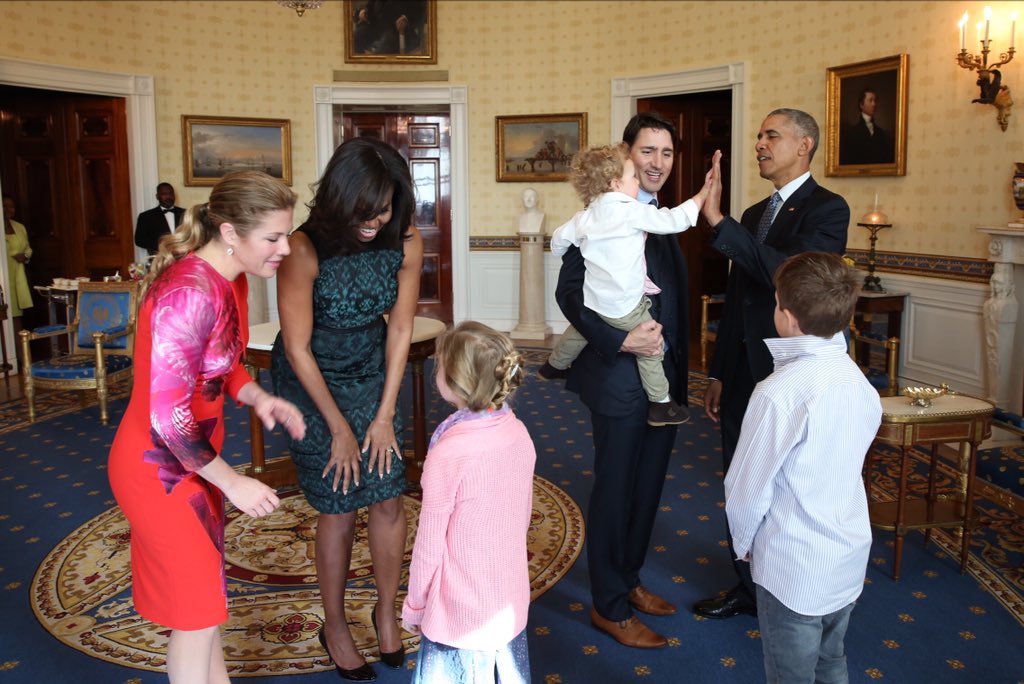
 Hadrian, the youngest Trudeau was a big hit with the Obamas

Trudeau's White House visit is a high-profile embodiment of his new government's drive to put Canada back on the global stage. To achieve this, Canada needs to leapfrog forward in a manner commensurate with the world's fast-shifting contours.
We need to see new efforts in education, research, non-profits, business, investment and in our civil society. If our academics, business people and politicians all do their parts, Canada will indeed be back - and for the long haul.
In February, Trudeau fulfilled a campaign pledge by halting Canadian air strikes on ISIL rebels in Iraq and Syria. While this dented Obama's multi-nation force against the radicals, Trudeau boosted his deployment of military trainers to Iraqi Kurdistan and
decided to open the doors to 25,000 Syrian refugees, with plans for more. Conservatives liken Trudeau's overtures towards Muslims to Obama's refusal to link Islam with violence. Shabnam Assadollahi, an Iranian-Canadian rights campaigner, sees problems down the line.
"Trudeau has been called Canada's Obama for his lack of experience, socialist philosophy and tendency to circumvent parliamentary debate and elected officials. Like Obama, his tax-and-spend policies will leave future generations paying the bill," Assadollahi said.
"Trudeau's embrace of Islam and large numbers of Middle Eastern refugees is seen by many in the US as gullible and a golden opportunity for religious radicals. Only time will tell what impact these soft policies have on North American security."


Trudeau said he will not "pick a fight" with Trump, despite the billionaire's diatribes against Muslims, Mexicans and others. Rather, the Liberal leader would doubtless have more shared policy priorities with a Democrat replacing Obama in the Oval Office.
Trudeau remains impartial, but one Canadian website has sparked a flood of interest for suggesting that Americans should abandon the US and move to a Nova Scotia island if Trump wins November's ballot.
Since "Cape Breton if Donald Trump Wins" went up on February 16, the website has attracted hundreds of thousands of disillusioned American visitors and floods of emails asking about job opportunities and work visas.


In turn, Trudeau has invited the Obamas to Canada. Obama's final visit to Canada could coincide with the North American leaders summit (also called the Three Amigos) Canadians will host this summer. The leaders of the United States, Mexico and Canada will meet to further alliance and trade and cement relations among the countries of North America.


Climate Change: This is the statement we hard core environmentalists were waiting to hear

Thursday began with a joint statement on climate change that includes a new science partnership on the Arctic, part of work under the United States' chairmanship of the Arctic Council. Trudeau thanked Obama for his leadership to date on the climate change file.
"The president and I share a common goal: We want a clean growth economy that continues to provide good jobs and great opportunities for all of our citizens," Trudeau said.
But the broad range of issues mentioned in the leaders' remarks — from continental collaboration to fight the Zika virus to Obama's praise for Canada's efforts on Syrian refugees — conveyed much more common ground.


Prime Minister  Trudeau and U.S. President Barack Obama have agreed to take joint steps to fight climate change, including cutting methane emissions from the oil and gas industry and protecting the Arctic. Canada and the U.S. issued a joint statement outlining those steps ahead of a meeting Thursday between the two leaders in the Oval Office on Trudeau's first full day on an official visit in Washington.
Reducing methane emissions from the oil and gas sector is a main commitment laid out in the statement, setting a goal of reducing them by 40 to 45 per cent below 2012 levels by 2025.
Environment Canada will regulate emissions from new and existing oil and gas sources, the statement said, and move "as expeditiously as possible" to implement national  regulations in collaboration with the provinces and territories and other stakeholders. The department intends to publish an initial phase of proposed regulations by early 2017.
The U.S. Environmental Protection Agency (EPA) will develop regulations on the south side of the border and starting next month will start a process to require companies to provide information about their methane emissions.
"We know that by tackling methane emissions, we can continue to unlock amazing opportunity to better protect our environment for the future," Gina McCarthy, the EPA's administrator, said in a call with reporters.
Environmental groups welcomed the announcement, pointing out that methane is a more potent greenhouse gas than carbon dioxide and it will be important to control it over the next 25 years.
"About one-quarter of the climate change we're experiencing now is actually driven by emissions of methane," said Diane Regas, executive director of the Environmental Defense Fund.

She said it is very "doable" for oil and gas firms to control methane emissions and quite inexpensive, as the technology already exists.

"Most companies, we don't know how much they emit. We don't know what their targets for reductions are or how they are doing, so regulations will help on all fronts," she said.
Both countries also committed to reducing emissions from hydrofluorocarbons (HFCs), and said in their public procurement processes that they will seek to buy greener equipment and products.


Paris a 'turning point'

They also said they would continue to collaborate on emission standards for vehicles, and would work on adopting a carbon offset measure in 2016 for the aviation sector.
The two countries also intend to align the ways they assess the impact of greenhouse gas emissions caused by major projects, and co-ordinate measures to reduce those emissions. The White House said given the integrated nature of their economies, it is mutually beneficial for Canada and the U.S. to work together on GHGs. This will mark the first time the two countries will collaborate on calculating the effects of these projects on the environment.
The announcement said Obama and Trudeau consider the agreement reached in Paris a "turning point" in global efforts to combat climate change, and they will work together to implement it, committing to joining it and signing it "as soon as feasible."
Another part of the joint plan involves co-operating on clean energy. The two countries intend to collaborate on expanding wind, solar and other renewable energy sources and on clean energy research.
Officials had suggested earlier in the week that the efforts to address the effects of climate change in the Arctic would be part of the plan, and indeed Trudeau and Obama announced a new partnership to "embrace the opportunities and to confront the challenges in the changing Arctic."


Protecting the Arctic

It includes sticking to the goals of protecting at least 17 per cent of land areas and 10 per cent of marine areas by 2020, and ideally going beyond those goals, the plan said. Obama and Trudeau want to engage other Arctic nations to develop a pan-Arctic marine protection area network.
The plan also talks about building a sustainable Arctic economy, and says commercial activities will only occur when the highest safety and environmental standards are met. Shipping corridors will be developed to have as little impact as possible on the environment.
"The Arctic is a  leading indicator of what the planet faces in the years and decades ahead," Sally Jewell, secretary of the interior, told reporters.
Trudeau and Obama also want a binding international agreement to prevent the opening of unregulated fisheries in the central Arctic, and Canada has offered to host talks.
When it comes to oil and gas exploration in the Arctic, the agreement says if it proceeds, it must align with science-based standards and include "robust and effective" well control and emergency response measures.


'Some progress' on softwood lumber 

Environment Minister Catherine McKenna and Fisheries Minister Hunter Tootoo, the MP for Nunavut, are on the trip with Trudeau, along with Defence Minister Harjit Sajjan, Foreign Affairs Minister Stephane Dion and International Trade Minister Chrystia Freeland, who are all meeting with their Washington counterparts.
Freeland's file — the ongoing softwood lumber trade dispute — was expected to be raised at every opportunity.
White House officials said they welcomed Canada's interest but the Trans-Pacific Partnership deal was at the top of their list of trade issues.
A Canadian release said that the two sides have agreed to explore all options and report back within 100 days.
 All in all not a bad visit and the Obamas enjoyed the Trudeau kids.

Friday, March 11, 2016

The Roving Reporter :Canada's Justin Trudeau brings a warm front to Washington

President Obama welcomes Prime Minister Trudeau to the Oval Office on March 10 . Though Trudeau's predecessors made regular trips to Washington , this is  the first visit by a Canadian premier in 19 years.
By Nicole Gaouette and Kevin Liptak, CNN
Washington (CNN)Canadian Prime Minister Justin Trudeau's Thursday visit to the White House has the administration beaming even as American presidential candidates are bashing a central pillar of U.S.-Canada ties.

Trudeau's trip is expected to yield announcements on the environment and border security and cover shared security challenges in the fight against ISIS.

The 44-year-old leader's arrival marks the first official visit by a Canadian prime minister in 19 years. The schedule will involve a special level of pomp and circumstance to signal White House pleasure that after nine years of conservative rule, its northern neighbor now has a like-minded leader in office.

"The new prime minister would fit almost perfectly in the Democratic Party alongside the American president," said Michael Byers, a professor of international politics at the University of British Columbia.

Trade and climate change will top the agenda, according to White House officials. And though Trudeau pledged on the campaign trail to downgrade some of Canada's presence in the Middle East to fight ISIS, he has expanded collaboration with the U.S.-led coalition, earning the Obama administration's appreciation.

President Barack Obama's top climate envoy, Todd Stern, said the administration is eyeing a reduction in methane emissions as one potential takeaway from the visit. Administration officials also hope to make progress in resolving a long-running dispute over lumber imports into the United States.

Mostly, the White House is seeking to underscore what they regard as deep similarities between Obama and Trudeau.

Shared values and interests haven't prevented tensions, though. Republican and Democratic presidential candidates have ripped into the North American Free Trade Agreement, which sets the rules for free-flowing trade between the U.S., Canada and Mexico.

Sanders campaign: Michigan win due to trade message

Sanders campaign: Michigan win due to trade message 01:46
Republican candidate Donald Trump called NAFTA "a disaster" in a September interview with CBS, vowing that after his victory the U.S. will either "renegotiate it, or we will break it." And he continued to hammer away on trade leading up to Michigan's primary Tuesday.

Democratic candidate Bernie Sanders, meanwhile, attacked rival Hillary Clinton in Flint, Michigan, on Sunday for supporting the deal, virtually borrowing Trump's words when he called the trade pact "disastrous."

Even Obama has attempted to distance himself from the deal, which he noted last year was under negotiation when he was still in law school. In promoting the Trans-Pacific Partnership trade plan, Obama has pushed back on suggestions that it is simply a newer version of NAFTA, saying "that's not the trade agreement I'm passing."

"To see NAFTA become anathema and have the candidates distance themselves from their largest trading partner is very worrying" for Canadians, said Laura Dawson, director of the Canada Institute at the Wilson Center, a Washington think tank.

Canadians want to update the agreement to reflect whole realms of business that weren't covered in the accord, such as e-commerce.

But it's not expected that Obama would be willing to engage in NAFTA discussions as he works to gain support for his own trade plan before he leaves office. And focusing on NAFTA wouldn't help Clinton, who is now disassociating herself from a deal she supported when her husband, then-President Bill Clinton, signed it into law.

"Because the word NAFTA is political poison, it can't be updated" right now, said Dawson.

There are other trade issues also at play over the three-day visit. Trudeau, who took office in November, will wrestle with President Barack Obama on thorny issues including a disagreement on softwood lumber.

The U.S. is reluctant to renew a 2006 agreement that came under attack from U.S. lumber producers who said Canadian timber was unfairly subsidized. The deal expired in October 2015 and if it's not renewed by this October, Canadian producers could pay new tariffs.

Related : Obama rejects Keystone XL pipeline 

Even so, the Trudeau-Obama bond is already widely seen as an improvement over relations between the Obama administration and former Canadian leader Stephen Harper.

Their ties ground down over opposing views on several issues, including the environment and climate change -- particularly expansion of the Keystone XL pipeline that would have ferried oil from eastern Canada to refineries in the U.S.

Obama rejected the proposal in November after a seven-year review, citing climate change concerns. Harper, from oil-rich Alberta, had vociferously championed the pipeline, and didn't share Obama's climate change concerns. In contrast, though Trudeau would have preferred the deal, it hasn't been a cornerstone of his agenda or his posture toward the U.S. and he and the White House are more in line on many other environmental concerns.

The political chasm between Harper and Obama manifested in a number of ways, "most notably in the almost complete freezing out of Obama's ambassador to Canada," Byers said. "He could hardly get a meeting with a government official during his last six months in Ottawa."

There was some concern in the U.S. about cooperation with Canada in the Mideast when Trudeau won in part on his campaign pledge to pull Canadian fighter jets from the fight against ISIS. That was quickly put to rest.

On February 8, Trudeau announced Canada would send more military personnel to northern Iraq and increase its intelligence efforts in the region, contributing an aerial refueling aircraft and up to two manned aerial surveillance planes.

Trudeau on keeping Canada safe AND inclusive

Trudeau on keeping Canada safe AND inclusive 01:39
"Canada continues to play a critically important role" in the effort to defeat ISIS, Roberta Jacobson, assistant secretary of state for Western Hemisphere affairs, said Tuesday.

Trudeau's commitments, good through March 2017, "are very much in line" with the needs of the anti-ISIS coalition, she said.

Trudeau's pledge boosted Canadian military personnel on the ground to about 830 people who will help with operational planning, intelligence and targeting.

Some of those Canadians are "training the Kurds how to paint targets for laser-guided bombs," said Byers of the University of British Columbia. "They're actually designating targets -- it's as close to a combat role you can get while still calling yourself a trainer."

The nature of the work means they "will almost certainly take casualties as a result," he said.

Security closer to home is likely to be the focus of one agreement Trudeau and Obama are expected to announce during the visit: an arrangement to share exit and entry information on American and Canadians crossing the border, according to U.S. officials.

And an agreement on climate change and the environment -- a priority for both men -- is also expected.

The Globe and Mail, citing Canadian Cabinet ministers, said that announcement could involve tighter fuel and auto-emission standards and steps to promote electric cars, charging stations and ride-sharing apps.

"The commitment of both leaders to addressing this global challenge is clear," Stern, the climate envoy, said Tuesday, referring to climate change. "And I suspect under their leadership, North America will make significant progress this year and next."


The Roving Reporter                    G .

Thursday, March 10, 2016

Why can't we send all our garbage to the sun to be burned up...To my favorite Cubs


In theory, it sounds like the perfect solution, no? But there are a few glitches. I have asked about this before but got mostly negative responses, many people saying the cost would be too high, and it would be too difficult to get there because of the extreme heat, and the spaceship would melt, but lets just take a deep breath and have another look at it!
The real beauty and simplicity of this idea is that you dont have to go all the way to the sun, you can just dump the payload somewhere out near Mercury and turn around and gravity will do the rest! Gravity is your friend so dont fight it OK?
Also the spaceship doesnt have to be manned it can be remotely controlled so there is a huge cost saving as there is no need for a life support system, the garbage would just melt harmlessly into the sun and life would go on as always.
The government could introduce a 2% garbage tax to cover the cost, I think most people would agree that this is very reasonable. There could even be a garbage lottery to raise money for this noble cause, the Earth would be a much better place if we werent constantly surrounded by empty KFC boxes, diet pepsi bottles and used condoms, now that I have straightenedout the financial and technical problems what exactly is stopping us from getting this project off the ground?  It sounds so simple.

Weeeell, the cost is actually astronomical:

Don't forget the theory requires :
1.) A vehicle to transport to the Sun ( or nearby)
2.) The price to build the vehicle ( materials & man hours)
3.) The Fuel we will use to transport the garbage. (It would be cheaper to drive the spaceship directly into the sun -- no fuel needed for a return trip).
4.) The time (man Hours) to collect, load the garbage onto the vehicle  and guide it remotely to it's destination.
  At present, it costs several 100 million dollars to launch anything, so a single launch would cost every man, woman, and child about 3 cents per launch (which doesn't include the fuel to get to Mercury, turn around and come home). So how many launches do you think it would take to remove all the trash? I have to think it would require at least one launch for every city per day. That drives up the cost again.
 
The greatest cost would be just getting the vehicle past the earth's atmosphere. If we could build a space elevator, which has been already been discussed in scientific circles, and just get the garbage ship past the atmosphere, it would save a lot of money.  And if we could build a catapult on top of the space elevator, we could just catapult containers of garbage into space. That would be much cheaper. They probably would not get to the sun that way, but be pulled into Mercury's orbit and we would just be littering space because garbage just keeps coming day after day.

A second glitch to note is that if we start sending all of our trash out to outer-space we won't have much left on earth after a while to re-cycle and thus lose many possible resources.

Glitch number3:

 NASA currently has two probes orbiting the sun, so the technology exists to get the job done. Alas, the benefits fall far short of the risk involved. If we included nuclear waste in the garbage, the danger becomes ten fold.
There isn't a space agency or private firm on the planet with a spotless launch record. And we're not talking about cheapo rockets—last year, the craft carrying NASA's $280-million Orbiting Carbon Observatory fizzled out and crashed into the ocean near Antarctica. It's a bummer when a satellite ends up underwater, but it's an entirely different story if that rocket is packing a few hundred pounds of uranium. And if  it exploded above earth and the uranium caught fire, it could stay airborne and circulate for months, dusting the globe with radioactive ash. Still seem like a good idea?

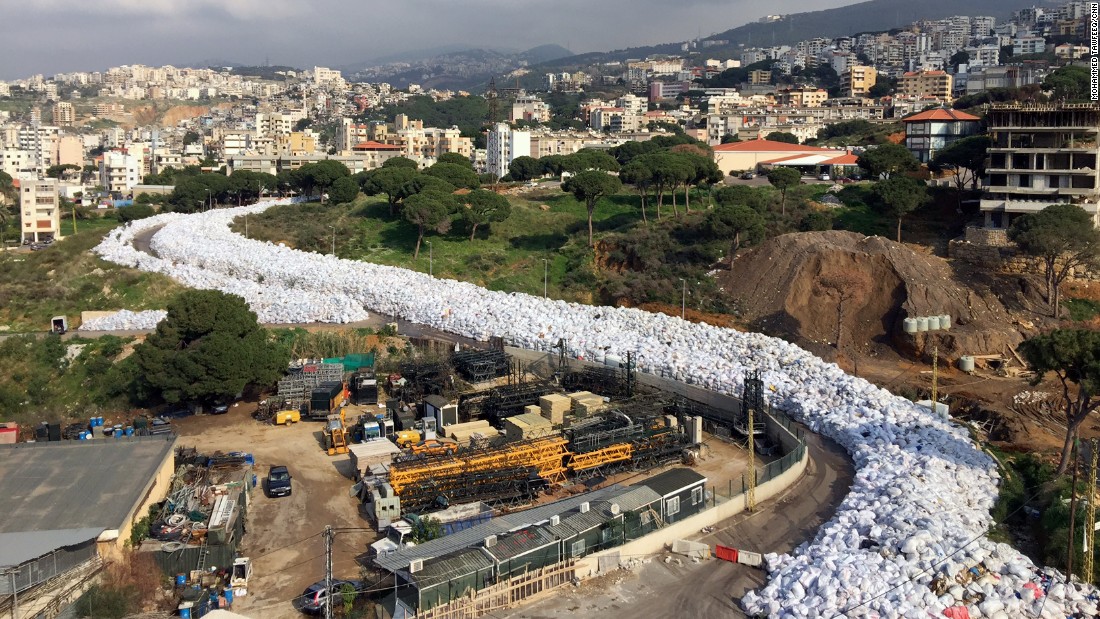
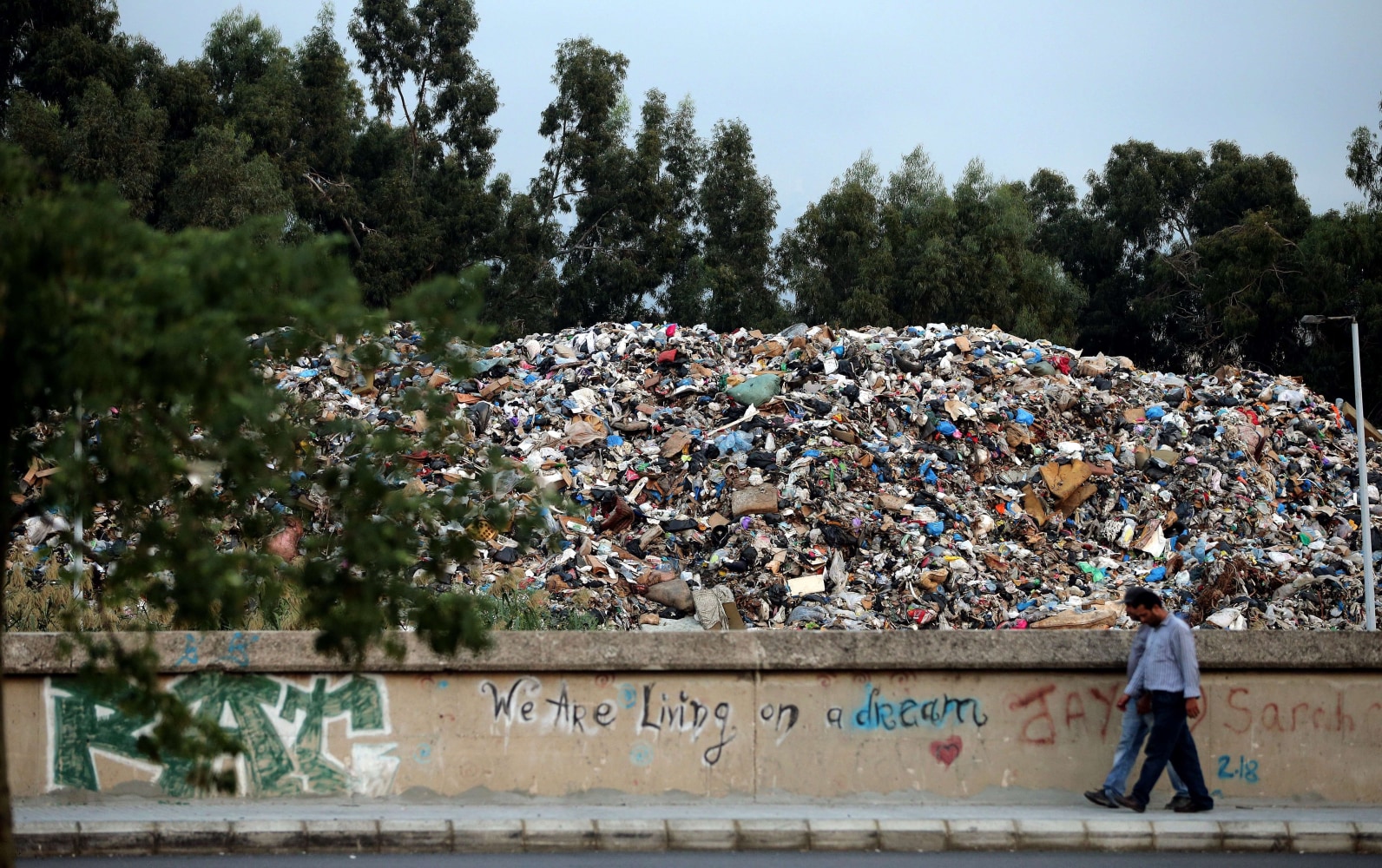
The pictures below are of the river of garbage bags in the city of Beirut in Lebanon where the garbage has not been collected and removed in weeks.  They made an agreement with Russia to send all their rubbish there but the negotiations fell through. This could happen to any of us, anywhere, any time, when the collection system breaks down. They are in an environmental crisis.


Maybe we should, first, learn how to handle the waste problems better right here on earth. We all have to recycle materials that can be used again and find efficient, environmentally friendly ways to burn up waste that cannot be used. We should also  compost organic materials and return them to the earth or use them as fertilizer. Some day we will figure out how to use all waste as an energy source but that could be a hundred years from now.
Until then, being a very lazy species, we will try to find an easy way to dump stuff. The latest ideas include dumping trash in volcanoes or down a hole drilled to the center of the earth. And the one I like the best...tell the people at Cern to create a black hole and throw everything in the hole. Do you think those are good ideas? Or do you have a better one?
Love you guys
 Aunt Jeannie