Monday, February 22, 2016

Watcha think about this?... Russia wants to fly surveillance planes over the US


 Russian President Vladimir Putin speaks during his annual end of year news conference in Moscow, Russia. Russia will ask permission on Monday, Feb. 22, 2016, to start flying surveillance planes equipped with high-powered digital cameras amid warnings from U.S. intelligence and military officials that such overflights help Moscow collect intelligence on the United States. (AP Photo/Alexander Zemlianichenko, File)

In keeping with our last post, this article supports the theory that Russia is gearing up for cold war or worse. See what you think.
Russia will ask permission on Monday to start flying surveillance planes equipped with high-powered digital cameras amid warnings from U.S. intelligence and military officials that such overflights help Moscow collect intelligence on the United States.

Russia and the United States are signatories to the Open Skies Treaty, which allows unarmed observation flights over the entire territory of all 34 member nations to foster transparency about military activity and help monitor arms control and other agreements. Senior intelligence and military officials, however, worry that Russia is taking advantage of technological advances to violate the spirit of the treaty.
Russia will formally ask the Open Skies Consultative Commission, based in Vienna, to be allowed to fly an aircraft equipped with high-tech sensors over the United States, according to a senior congressional staffer, who spoke on condition of anonymity because the staff member wasn't authorized to discuss the issue publicly.
The request will put the Obama administration in the position of having to decide whether to let Russia use the high-powered equipment on its surveillance planes at a time when Moscow, according to the latest State Department compliance report, is failing to meet all its obligations under the treaty. And it comes at one of the most tension-filled times in U.S.-Russia relations since the end of the Cold War, with the two countries at odds over Russian activity in Ukraine and Syria.
"The treaty has become a critical component of Russia's intelligence collection capability directed at the United States," Adm. Cecil D. Haney, commander of the U.S. Strategic Command, wrote in a letter earlier this year to Rep. Mike Rogers, R-Ala., chairman of a House subcommittee on strategic forces.
"In addition to overflying military installations, Russian Open Skies flights can overfly and collect on Department of Defence and national security or national critical infrastructure," Haney said. "The vulnerability exposed by exploitation of this data and costs of mitigation are increasingly difficult to characterize."
A State Department official said Sunday that treaty nations had not yet received notice of the Russian request, but that certification of the Russian plane with a "digital electro-optical sensor" could not occur until this summer because the treaty requires a 120-day advance notification. The official spoke on condition of anonymity because he wasn't authorized to discuss the issue publicly.
The official also said that the treaty, which was entered into force in 2002, establishes procedures for certifying digital sensors to confirm that they are compliant with treaty requirements. The official said all signatories to the treaty agree that "transition from film cameras to digital sensors is required for the long-term viability of the treaty."
In December, Rose Gottemoeller, undersecretary of state for arms control and international security, sought to temper concerns about Russian overflights, saying that what Moscow gains from the observation flights is "incremental" to what they collect through other means.
"One of the advantages of the Open Skies Treaty is that information — imagery — that is taken is shared openly among all the treaty parties," she said at a joint hearing of the House Foreign Affairs and Armed Services committees in December. "So one of the advantages with the Open Skies Treaty is that we know exactly what the Russians are imaging, because they must share the imagery with us."
Still, military and intelligence officials have expressed serious concern.
"The open skies construct was designed for a different era," Lt. Gen. Vincent Stewart, director of the Defence Intelligence Agency, told lawmakers when asked about the Russian overflights during a congressional hearing. "I'm very concerned about how it's applied today."
Robert Work, deputy secretary of defence, told Congress: "We think that they're going beyond the original intent of the treaty and we continue to look at this very, very closely."
Steve Rademaker, former assistant secretary of state for the bureau of arms control and the bureau of international security and nonproliferation, told Congress at a hearing on security co-operation in Europe in October that Russia complies with the Open Skies Treaty, but has "adopted a number of measures that are inconsistent with the spirt" of the accord.
The treaty, for instance, obligates each member to make all of its territory available for aerial observation, yet Russia has imposed restrictions on surveillance over Moscow and Chechnya and near Abkhazia and South Ossetia, he said. Russian restrictions also make it hard to conduct observation in the Kaliningrad enclave, said Rademaker, who believes Russia is "selectively implementing" the treaty "in a way that suits its interests."


 Thanx to the Canadian Press

U.S.-Canada ponder cruise missile warnings

Navy Vice Adm. Bill Gortney, director of the Joint Staff, gives an operational update concerning Libya, at the Pentagon in Washington, Sunday, March 20, 2011. 


Navy Vice Adm. Bill Gortney, director of the Joint Staff, gives an operational update concerning Libya, at the Pentagon in Washington, Sunday, March 20, 2011. The commander of NORAD says U.S. and Canadian defence planners are taking notice of Russia's use of cruise missiles in Syria, something that could have wide-ranging implications for the West ??? particularly in the Arctic. Gortney tells The Canadian Press that multiple strikes on Raqqa, the de facto capital of the Islamic State of Iraq and the Levant, show Russian aircraft don't have to leave their airspace in order to deliver lethal effects.THE CANADIAN PRESS/AP Photo/Cliff Owen


OTTAWA - The bloody, sun-baked sand of Syria is a long way from the Canadian Arctic, but Russia's use of cruise missiles in the five-year-old civil war has defence planners in both the U.S. and Canada sitting up and taking notice.
U.S. Admiral Bill Gortney, the commander of Norad, said multiple strikes on Raqqa — the de facto capital of the Islamic State of Iraq and the Levant — show Russian aircraft don't have to leave their airspace in order to deliver lethal effects.
The missiles, launched last November, came from Tu-160 and Tu-95 warplanes and warships in the Caspian Sea and travelled thousands of kilometres to hit their targets. Those attacks were followed in December by submarine-based launches of Kalibr cruise missiles.
In an exclusive interview with The Canadian Press, Gortney said the message intended for the West was crystal clear.
"There was no tactical or operational requirement for any of those shots," he said. "They were telling us they have this capability and can employ it globally."
The Trudeau government is about to embark on a defence policy review, but unlike its Conservative predecessor, which emphasized military preparedness in the Arctic, the issue has barely registered in Liberal policy statements.
One of the pressing issues will be replacing the rapidly aging north warning system of radar stations over the next decade.
But defence planners in both Washington and Ottawa have in recent years been quietly warning about the threat of a surprise cruise missile attack from the Far North. Most of their research, however, has focused on rogue nations or terrorist threats from converted ships operating in the Northwest Passage.
They have warned, however, that the absence in the Arctic of radar protection at low levels below 3,000 metres means there would be very little warning of a cruise missile launch in the region.
Gortney said Norad can track ballistic missiles coming over the North Pole, but coverage for low-flying cruise missiles remains a major challenge. American and Canadian planners are together trying to figure out a solution, he said.
"Against this particular threat, you need the ability to look over the horizon," Gortney said. "Does that mean it needs to be airborne — or land based? Or a combination of both?"
The harsh environment poses a bit of conundrum, he added.
One possible solution would be an aircraft carrier-based E2D-Hawkeye surveillance plane, which has been fully tested electronically. But Canada has neither the plane nor the ship, and American use of both would depend on weather.
Norad planners are also experimenting with the use of static balloons with a load of surveillance gear.
"Because of the nature of the Arctic, a balloon might not be the best option," Gortney said.
The Canadian military has been studying the idea on its own, and has considered the possibility of installing static surveillance balloons at choke points along the Northwest Passage.
The aerospace command is also responsible for monitoring maritime approaches to the continent. A number of defence journals and open-source intelligence reports have noted that Russian submarine activity in the North Atlantic has now surpassed Cold War levels — something Gortney confirmed.
Yves Brodeur, Canada's former ambassador to NATO, recently said Russia has become a more unpredictable actor on the world stage and that the alliance was caught flat-footed by the annexation of Crimea in 2014.
"We never saw it coming," Brodeur told a defence conference last week.
"It says something about the early warning systems. We ended up trying to catch up with something we didn't quite understand."
A lot of Canadian citizens, myself included, have been saying for years that Russia has eyes on Canadian territories in the Arctic. Some politicians have lobbied for a stronger military presence in the north, where we are most vulnerable, but little attention has been paid to the situation. To give Mr Harper credit, he was more aware and concerned about Russian aggression in the north, but even he had no long range plans.
We stand alerted and warned. Russia is taking the world stage as an aggressor and threat to world peace (Once more).  Why is it always about world domination?  While the  global community is focused on ISIS, Russia is taking advantage of the chaotic situation to sneak up on the world with military might, under the guise of assistance.  Putin must sense a certain weakening in the west a certain relaxing of military vigilance unless it pertains to terrorists. We can see the icy fingers of a future 'cold war' gradually gaining a stranglehold on a divided world. The two big guys, Russia and the USA facing off...we've been here before. And why is Russia suddenly so bold and confident ?? Does China have their back? What good will our heightened awareness do us if we don't take some kind of defensive or forestalling action?


Thanx to the Canadian Press for providing materials
           

Saturday, February 20, 2016

Hillary Takes Nevada


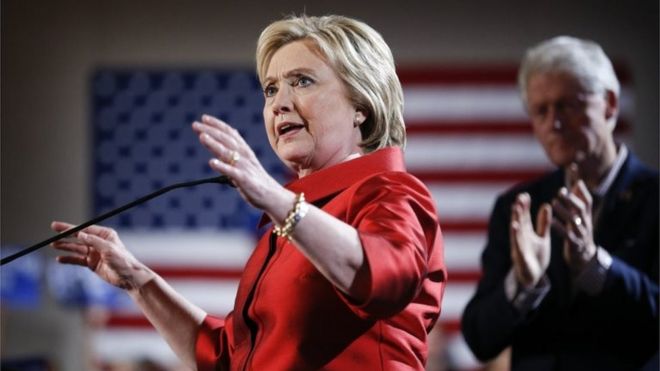
Democratic presidential candidate Hillary Clinton arrives on stage for a Nevada Democratic caucus rally, on 20 February 2016, in Las Vegas.


US presidential hopeful Hillary Clinton has narrowly won the Nevada caucuses in the latest stage of the Democratic race for presidential nominee. She is leading with 52% of the vote over her rival Bernie Sanders' 48%. She had been hoping for a big victory in Nevada where she is popular with Hispanic and minority voters. The Republican primary is also under way in South Carolina, where frontrunner Donald Trump is trying to fend off Texas Senator Ted Cruz.
The votes could be key ahead of the "Super Tuesday" round on 1 March. On that day, about a dozen states will choose their Republican and Democratic contenders for the 8 November presidential election, with about a quarter of all nominating delegates up for grabs.
Hillary Clinton, who won Iowa but was beaten convincingly in New Hampshire by Mr Sanders, declared victory in a tweet, thanking people who voted for her, saying "this is your win".
"Some may have doubted us, but we never doubted each other," Mrs Clinton told supporters at a victory rally in Las Vegas. "This is your campaign."
The presidential race between Hillary Clinton and Bernie Sanders has grown increasingly close in recent weeks, with the former secretary of state expected to win Nevada in double digits just weeks ago. But the Vermont senator, who has successfully galvanized young voters with his calls for free university education, appears to have performed better than expected with the heavy minority population in Nevada.
According to NBC exit polls, Mr Sanders won among Hispanics with 53% of the vote but lost among black voters earning just 22% of their vote.
"Five weeks ago we were 25 points behind and we ended up in a very close election. And we probably will leave Nevada with a solid share of the delegates," Bernie Sanders said in a statement on his rival's victory.               
The state represents the most racially diverse battleground so far, with both candidates courting the vote of African Americans, Hispanics and Asian Americans, who make up about 50% of the state's population.


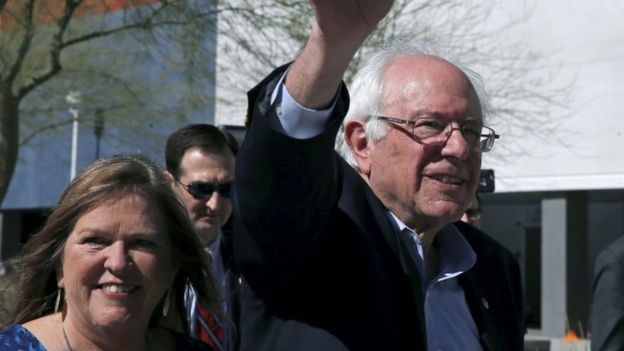
Democratic presidential candidate Bernie Sanders and his wife Jane visit a caucus site in Las Vegas, Nevada 20 February 2016.
Mrs Clinton overcame an unexpected strong surge by Vermont Senator Bernie Sanders in Nevada on Saturday

The state represents the most racially diverse battleground so far, with both candidates courting the vote of African Americans, Hispanics and Asian Americans, who make up about 50% of the state's population.
Elsewhere, in South Carolina, Republican supporters are choosing who they want to see run for the White House . We will soon have that result

Friday, February 19, 2016

Yosemite Firefall


Shot yesterday 2/15/2016. One of the most stunning moments in Yosemite National Park. We hiked about an hour from Southside Dr to a high plateau where you have full view of the tunnel from the Village perspective.The setting sun hits Horsetail Falls at just the right angle to illuminate the upper reaches of the waterfall. And when conditions are perfect, Horsetail Fall glows from white to gold, red at the peak, then fades out quickly after 20 minutes.

Photographer from ZitherFilmography 

Thursday, February 18, 2016

Trump is not a Christian says the Pope


The Pope has questioned US Republican presidential candidate Donald Trump's Christianity over his call to build a border wall with Mexico. Pope Francis said "a person who thinks only about building walls... and not of building bridges, is not Christian".

The New York businessman supports deporting nearly 11 million undocumented immigrants. Calling himself a "proud Christian", Mr Trump blamed Mexico for the Pope's remarks, calling them "disgraceful". Mr Trump has alleged that Mexico sends "rapists" and criminals to the US.

Pope Francis made the comments at the end of a six-day trip to Mexico.
"A person who thinks only about building walls, wherever they may be, and not of building bridges, is not Christian. This is not the gospel," he said.  He declined to say whether Americans should vote for Mr Trump, who is leading the Republican race for president.
"I say only that this man is not Christian if he has said things like that. We must see if he said things in that way and I will give him the benefit of the doubt," the Pope said.

In response to a question about whether contraception was allowed to prevent the transmission of the Zika virus, the Pope said that for some cases the "lesser of two evils" can be used. He said abortion "is a crime, an absolute evil," but that avoiding pregnancy is not.

Addressing a rally in South Carolina, Mr Trump responded to the Pope's comments.
"For a religious leader to question a person's faith is disgraceful. I am proud to be a Christian," Mr Trump said. "No leader, especially a religious leader, should have the right to question another man's religion or faith."
"[The pope] said negative things about me. Because the Mexican government convinced him that Trump is not a good guy," he said.


Did Mr Trump need to take on the Pope? Well, almost certainly yes.  Because in god-fearing South Carolina, the next state to vote in the primary process - to have the Pope say that he is unchristian is potentially very damaging.
And over the course of the campaign, the billionaire property developer has been at pains to prove his religious credentials, appearing at rallies with a copy of the Bible that his mother had given him as a child.
He also said the Vatican was the so-called Islamic State group's "ultimate trophy" and that if it attacked, "the Pope would have only wished and prayed that Donald Trump would have been president because this would not have happened".
Two of Mr Trump's Republican rivals, Marco Rubio and Jeb Bush, both Catholics, said they look to the Pope for spiritual guidance, not political direction. Mr Rubio said the US has a right and an obligation to control its borders.
Mr Bush told reporters he "supports walls where it's appropriate" and that "Christianity is between him and his creator. I don't think we need to discuss that".
Jerry Falwell Jr, the president of the conservative Christian Liberty University and a Trump supporter, told CNN that the Pope had gone too far.
"Jesus never intended to give instructions to political leaders on how to run a country,"
he said.

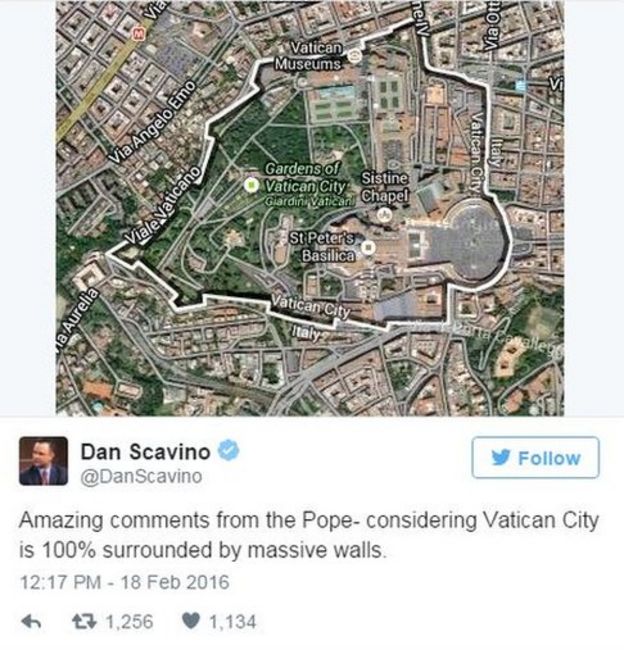
Trump campaign official Dan Scavino tweets: Amazing comments from the Pope- considering Vatican City is 100% surrounded by massive walls.

Earlier this month, Mr Trump called Pope Francis "a very political person" in an interview with Fox News.
"I don't think he understands the danger of the open border we have with Mexico," Mr Trump said.
American Catholics are seen as an important voting bloc in US elections. Many support Republican candidates because of their opposition to abortion and gay marriage.
Mr Trump has been courting the evangelical Christian vote, often successfully, but his fellow Republican rivals have tried to argue that his religiosity is not sincere.


Trump's religious views: In his own words

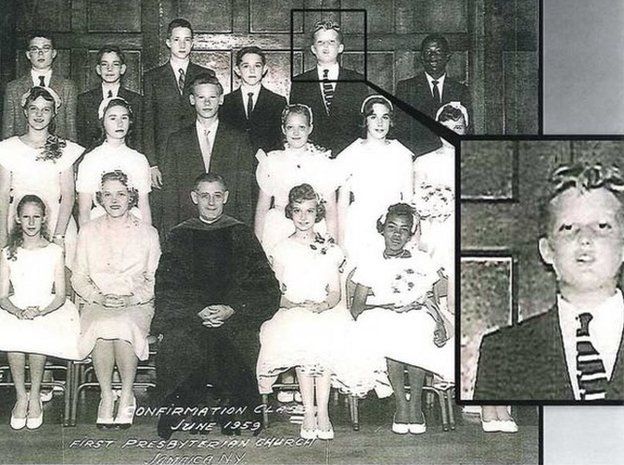
Donald Trump family photo


  • "I'm going to protect Christians" (January 2016)
  • "I think if I do something wrong, I think, I just try and make it right. I don't bring God into that picture. I don't" ( July 2015)
  • "I believe in God. I am Christian. I think The Bible is certainly, it is the book...I'm a Protestant, I'm a Presbyterian. And you know I've had a good relationship with the church over the years. I think religion is a wonderful thing. I think my religion is a wonderful religion." (2011)
  • His proposed Muslim ban: "Until we are able to determine and understand this problem and the dangerous threat it poses, our country cannot be the victims of horrendous attacks by people that believe only in Jihad, and have no sense of reason or respect for human life." (December 2015)
  • Muslims in general: "Most Muslims are wonderful people, but is there a Muslim problem? Look what's happening. Look what happened right here in my city with the World Trade Center and lots of other places." (2011)


  • Ted Cruz's campaign is now running an advertisement featuring a 1999 television interview Mr Trump gave in which he said he was "very pro-choice" when it comes to abortion.
    In January, Mr Trump faced ridicule after flubbing a Bible verse when giving a speech to a Christian university in Virginia. He has said he is a Presbyterian Christian but has had trouble recalling his favourite Bible verse when asked. He has referred to communion, the Christian sacrament signifying Jesus' last supper, as having "the little wine" and "the little cracker."
    Sooo, who wins, the Pope or the Donald ???

    Wednesday, February 17, 2016

    Tuesday, February 16, 2016

    Canada's missing or murdered indigenous women.....count 'higher than thought'

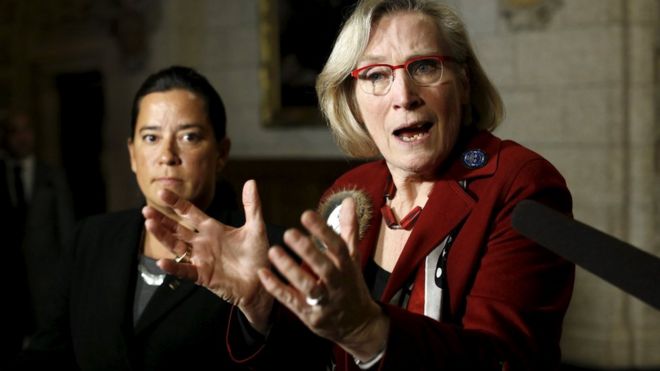
     Ms Bennett said the true figure of missing or murdered women is higher than previously thought

    The Canadian government has confirmed that the number of missing or murdered indigenous women in the country is higher than the previously reported. Ministers recently spoke to survivors across Canada to begin a government inquiry into the matter. Prime Minister Justin Trudeau made a key campaign pledge to address this.

    Canada's minister for the status of women suggested on Tuesday the accurate number of missing and murdered women could be as high as 4,000. Patty Hajdu said the government did not have an accurate figure but she indicated there was research from the Native Women's Association of Canada (NWAC) that said there were about 4,000.
    The often-cited 1,200 figure came from a 2014 Royal Canadian Mounted Police report on the missing women, related to the period between 1980 and 2012. And even that was grossly underestimated.
     The discussions revealed, from participants, friends, relatives and indigenous womens' councils, that the true figures may even be higher than 4,000, according to Indigenous Affairs Minister Carolyn Bennett.

     
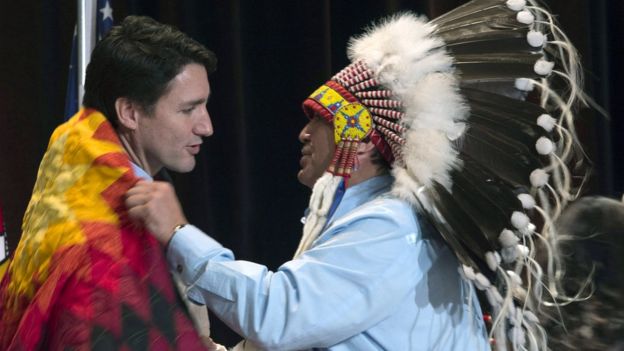
    Trudeau addressed the Assembly of First Nations in Quebec

    In December 2015, Canadian authorities charged a man in the death of one indigenous girl whose murder caused a national outcry. Raymond Cormier, 53, was charged with second-degree murder in the death of Tina Fontaine, 15, who was found dead in 2014 in Saskatchewan's Red River.
     An investigation in April revealed that dozens of aboriginal women disappear each year in that area, with many later found dead in the Red River. Mr Trudeau has promised an inquiry into missing and murdered indigenous women in an appeal to First Nations chiefs. The public inquiry will be a "top priority" of his newly-elected Liberal government, he said.
    Mr Trudeau has also promised increased funding for aid and other programs and a review of laws on indigenous peoples. Trudeau was appalled at the living conditions of the indigenous people in Northern Saskatchewan. He was shaken when he heard the true numbers of  dead or missing women, who have never been accounted for.
    The previous government has much to answer for. They ignored pleas for help from First Nations chiefs to investigate the missing women, and they promised but didn't deliver enough humanitarian aid for health and clean water and money for improvements.

    Minister of Justice Jody-Wilson Raybould, Minister of Status of Women Patricia Hajdu and Ms Bennett conducted interviews with nearly 2,000 people to start forming the government inquiry - survivors, families and loved ones of survivors.
    The ministers aim for the inquiry to, "examine the causes of violence against Indigenous women and girls and make recommendations for concrete actions to prevent future violence", said Ms Bennett.
    "Regardless of the number, the level of Indigenous women and girls who have gone missing or were murdered is an ongoing national tragedy that our government is committed to addressing immediately."
    Easy to say. We just hope we get to see genuine aid and improvements being provided.
    The responsibility also lays at the door of the provincial governments who have treated these people like second class citizens or worse. The federal government can't always ride herd on every situation. If the provincial governments can't deal or are overwhelmed by a problem, or are outraged by the way cases are handled, or not handled, by the Mounties, they should vigorously protest to the federal government. Up until now, the sound of silence has been deafening.
    Justin is not a miracle worker, nor should we expect him to be, but here is the crucible which will test just what he is made of.
    Sorry to end the post on a preposition.

    THE DEATH OF
    TINA FONTAINE LEADS TO ENLIGHTENMENT

    It was one of those never-ending summer days that John O'Donovan relished. 
    It was August 2014, and the detective from Winnipeg's homicide unit had just finished Sunday lunch with his family and was preparing to walk his dogs, retired greyhounds.
    But then the phone buzzed with a familiar number and O'Donovan knew his peace and quiet was about to end.
    It was his duty inspector with news that a body had been found weighted down in a bag in the Red River, the river that runs through Winnipeg and is the lifeblood of the city.
    Within an hour, O'Donovan was at his desk in the city speaking to officers and handing out assignments.
    The body was in such an advanced state of decomposition it took four hours to determine it was that of a young woman.  It was another few hours before detectives could settle on a tentative identification. 
    “We didn't know who she was or how old she was, or how long she'd been in the water,” says O'Donovan.  The river did a lot of damage.”


    Tina Fontaine


    A tattoo of angel wings on the back of the young girl pointed officers to a runaway, a 15-year-old school girl called Tina Fontaine.
    Within days Tina's case was making headlines throughout Canada not just for the horrific nature of her death, but for what she had come to represent. She brought national attention to the terrible situation we have been discussing.
    Tina Fontaine was from Canada's Aboriginal population - made up of First Nation tribes, Inuit from the far north and Metis, the descendants of French settlers and native Canadians. 
    Her murder was the latest in a seemingly never-ending stream of violent attacks against Aboriginal women and girls in Canada. With Aboriginal peoples making up less than 5% of Canada's population of 35 million, the numbers are  astonishingly high.
    “Winnipeg is a working city, it's always been one of those frontier towns, it's always been a tough town,” says O'Donovan who moved to the city 30 years ago from the west coast of Ireland.
    But, for reasons he could not reveal at that time, without compromising the investigation, Tina Fontaine's death horrified this hardy detective.  He said only that he had "feelings of outrage that a 15-year-old child has been killed”. 
    Months into the investigation, his wife pointed out to him that Tina was the only murder victim she had heard him refer to by her first name.  The teenager was not the first Aboriginal schoolgirl to have been murdered in Winnipeg, but the collective outrage that followed her killing marked a watershed for a city that had often shut its eyes to violence against Aboriginal women, not only in Winnipeg but throughout Manitoba and Saskatchewan.


    Fortunately Tina's case and many others were under investigation by Project Devote, a special task force set up in Winnipeg four years ago to investigate unsolved cases in Manitoba where the victim was deemed to have been “vulnerable”.
    A tour of the project room, jointly staffed by local officers and the national Royal Canadian Mounted Police, reveals pictures of all the 29 cases currently under investigation along with maps annotated with dots showing the last place each victim was seen, and, in some cases, where their body was found.
     
    So far, only two cases have been brought to court. Constable Jason Michalyshen says the challenges the team faces are considerable. 
    “Often with missing persons there's no scene for us to physically analyze or gather evidence,” he says.
    “We understand this is devastating for family members, but it's equally frustrating for investigators when we have limited information.”
     Despite its high profile and generous funding, Project Devote isn't doing enough.
    One victim's family said, “You don't get any answers from them. You get a phone call every month to say, you know, ‘We're working on the case... we have nothing further to tell you".
    “We really feel like because we're indigenous people in Canada that we're not taken seriously,” she says.
    "They just think no-one is waiting for us, that nobody cares about us, that we're disposable.”
    But Tina Fontaine did have someone waiting for her.  An hour's drive north up highway 59, in a cosy one-storey house just outside Sagkeeng Aboriginal Reserve, Tina's great aunt, Thelma Favel, never stopped hoping she would come home. 


    Thelma Favel
    Thelma Favel

    The reserve, which has a population of nearly 3,500, is like hundreds of others across Canada, separated from mainstream society and largely self-governed.  Thelma raised Tina and her younger sister here. Years earlier, she had looked after Tina's father, her nephew, when her sister couldn't cope. Often drugs and alcohol consume indigenous parents and the children are left to fare for themselves. Tina and her sister were lucky. They were raised in a comfortable home and loved. Thelma had taken in many abandoned or neglected children over the years.
    When Tina was fifteen she set out with $60.00 dollars in her pocket to visit her mother in Winnipeg and was never seen again. Her murder and it's investigation brought this dismaying, frightening situation to national attention, to people like myself who were ignorant of such horrifying events happening in our country.
    So who is killing Aboriginal women and girls?  A view widely held in Canada is that Aboriginal women face violence mainly from their own community. 
    The figures compiled by the Royal Canadian Mounted Police bear this out to an extent. Between 1980 and 2012, more than 60% of the recorded murders of Aboriginal women were committed by husbands, family members or close friends.  But this leaves nearly 40% of women who were killed by strangers or casual acquaintances, a term that is often used to describe the sex worker-client relationship. Aboriginal women are 1.4 times more likely to be killed by someone they aren't close to.

    The serial killer Shawn Lamb, convicted in Winnipeg in 2013 of murdering two Aboriginal women (and the prime suspect in another case) described them as “the perfect victim” because no-one seemed to care if they went missing. This may also be why a large number of Aboriginal women were among the victims of Canada's most infamous serial killer, the pig farmer Robert Pickton in British Columbia. 
    The remains or DNA of 33 women were found on his farm, when he was arrested in 2002. Some were hitchhikers, a number were prostitutes and drug addicts.


    In Winnipeg , many of the murdered and missing Aboriginal women disappeared while working on the streets. For the past few years, the Winnipeg police force has run a counter-exploitation unit, patrolling at night to keep an eye on women at risk. 
    “There is nothing safe about women working the streets in the sex trade,” says Sgt Cam Mackid who has worked this beat for the past 20 years.
    The unit spends each night driving around the known red light districts in Winnipeg's North and West End districts, befriending women, checking up on them and offering them a lift home. If the girls are under age, they refer them to Child and Family Services.
    “When we speak to girls we ask if there's any way to get them off the streets,” says Mackid.
    “We have no legal authority to take them off, but we do our best to make sure they're not taking risks.”
    As he puts it: “The streets are ground zero for predators.”
    Tina Fontaine’s death appears to have been a moment of awakening for Canada.
    Huge crowds joined rallies to protest against the murder, and thousands of women tweeted pictures of themselves holding signs asking the question “Am I Next?”
     Since Tina was killed, three more Aboriginal women have been murdered in Winnipeg.  Two of the deaths appear to be related to domestic arguments. In the third the perpetrator is unknown.  And at the beginning of April 2015, another 15-year-old Aboriginal schoolgirl was assaulted and left in a critical condition. 
    As the snow falls gently outside her home in Sagkeeng, Thelma Favel sits surrounded by pictures of Tina.  She's relieved that Canada seems to be waking up to the issue of violence against Aboriginal women, she only wishes this awareness had come sooner. 
    “It's going to be too late for Tina,” she says.
    “But at least it might help somebody else's child.”