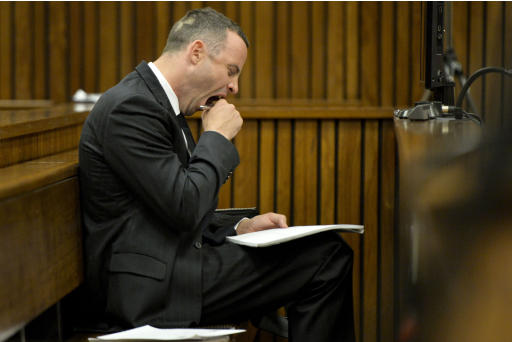
This was a day of unexpected drama in the courtroom, with the possibility of a
lengthy delay now hanging uncomfortably in the air. Speaking in court immediately after the adjournment, Oscar Pistorius protested
the prosecution's application to refer him for further psychiatric evaluation and said it
was "a joke" and insisted that today's evidence from Dr Merryll Vorster had
"gone well".
But the course of this already extended trial now hinges on Judge Masipa's
decision - likely on Tuesday - on whether to grant the prosecution's
request.
The defence has always maintained that the athlete's disability and
vulnerability would play an important role in their case - hence today's expert
who diagnosed his "general anxiety disorder". It is now clear Mr Pistorius' team
feel Prosecutor Gerrie Nel is "playing games". But the state believes the psychiatrist's evidence is further proof that the
athlete is changing his defence - from putative self-defence, to an accidental
shooting, to something now linked to his state of mind. The defense seems to morph as the situation calls for it.
From what journalists have gleaned from numerous sources in court, it is likely that
Judge Masipa will not grant the prosecution its request, but we shall know for
certain only when she announces her decision.
As the prosecution moved towards getting permission
from the judge for Mr Pistorius to be mentally assessed, the defense strongly opposed the application just prior to the court's adjournment Monday.
It
will reconvene on Tuesday. If the prosecution's request is granted, Mr Pistorius may spend up to 30 days
in a state mental health institution for observation and assessment of his
mental health.It was expected that the defence would conclude its case by the end of this week - after which both sides would have an opportunity to present their closing arguments.
Mr Pistorius still firmly maintains he accidentally shot Ms Steenkamp through the toilet door in a state of panic, mistaking the 29-year-old model and law graduate for an intruder. Giving evidence on Monday, Dr Vorster said that Mr Pistorius was more likely to respond to any threat with "fight" rather than "flight".
The anxiety disorder was the result of surgery at the age of 11 months to remove his lower legs, she said, a "traumatic assault" for an infant at that age. She said that Mr Pistorius felt remorse over Ms Steenkamp's death.
"He feels guilty and has developed a depressive disorder as a result," she said.

Family members of South African Paralympic athlete
Oscar Pistorius attended his trial on Monday
The couple had been dating for just a few months when
she was shot dead in 2013.The psychiatrist said that the reactions of Mr Pistorius in the early hours
of 14 February 2013 would have been different to that of a "normal, able-bodied
person without generalized anxiety disorder". However, she said that this would not have affected his
ability to distinguish between right and wrong and that it was up to the court
to decide whether his anxiety disorder - from which he had suffered since
childhood - diminished his responsibility.
"I think the generalized anxiety is relevant to the case. But the court will
have to decide," she said.
Dr Vorster said generalized anxiety disorders are not uncommon, and were not
signs of mental illness.
Safety measures at his home were "out of proportion" to the threat of crime
in South Africa, she said.
She said that Mr Pistorius' parents separated when he was six and his father was not a responsible parent. [He was] largely absent, and his mother was anxious, sleeping with a firearm under her pillow. "Mr Pistorius is certainly remorseful about the events... and has developed a depressive disorder".
She said that his mother's death in March 2002 meant that he lost an "emotional attachment figure".
State prosecutor Gerrie Nel asked Ms Vorster whether someone with anxiety disorder plus guns would be "a danger to society".
"Yes," she replied.

The order and trajectory of bullets that killed Reeva
Steenkamp is a key part of the case

Mr Pistorius suffered bouts of anxiety as child
because of his parents' separation and his disability, a psychiatrist
said

