Saturday, November 04, 2017

Trump’s year of anger, disruption and scandal

On Election Night last year, Trump ripped up his speech and made a personal appeal for national unity. It was a glimpse of a presidency that might have been.
By ANNIE KARNI and ELIANA JOHNSON 11/04/2017 
It was after midnight on Nov. 9, 2016, and Donald Trump was sitting at the kitchen table of his Trump Tower penthouse.

His win in the presidential race was so unexpected that his chief speechwriter, Stephen Miller, had only begun writing the victory remarks the president-elect would deliver to supporters gathered at the Hilton Midtown Hotel in the middle of the night.


Surrounded by a handful of campaign advisers, Trump started editing the speech by hand, striking some of the most belligerent lines, and inserting notes of unity. He read aloud softly to himself.

“Now it is time for America to bind the wounds of division.” He paused. “To bind? To heal? Which is better?” he asked his campaign manager, Kellyanne Conway, who was hovering close by. It was the mirror image of the scene unfolding in Hillary Clinton’s hotel room, where the Democratic nominee had a victory speech ready to go, but no concession to deliver.

Trump had been glued to the television, watching what was supposed to be Clinton’s Javits Center victory party — and taking note of the shocked faces in the crowd. “I think he was aware of how unexpected this was,” said his longtime aide, Hope Hicks, now the White House communications director, explaining the un-Trumpian unity rallying cry. “He wanted to give a speech that would de-escalate everything and, while the whole world was watching, be a leader for all.”

Onstage, Trump would say: “To all Republicans and Democrats and independents across this nation, I say it is time for us to come together as one united people. It’s time.”

It was a glimpse of a presidency that could have been.

Instead, in the year since that night, Trump has relished personal fights and nursed grudges; continued to vilify Clinton and defend his own legitimacy amid the expanding Russia probes; stirred racial tensions while measuring his success by the strength of his base; and taken more interest in throwing elbows on cultural issues than on the matters of policy that preoccupy Republican leaders in Congress.

The shock win also meant that the first six months of his tenure were hobbled by infighting among a band of government first-timers recruited to the White House on the basis of loyalty rather than merit.

Campaign-trail promises of a bipartisan, trillion-dollar infrastructure bill haven’t materialized in office. Republican lawmakers, who campaigned for seven years on promises to repeal Obamacare, failed even to pull together behind advancing a partial rollback before abandoning that effort in favor of another top priority: tax reform.

But Trump has nonetheless brought about an astonishing transformation of his party – and of American politics – over the last year.

His election marked the end of the conservative movement that controlled the GOP since Barry Goldwater’s campaign in 1964 and the rise of a nationalist-populist movement that is, for the time being, characterized by warring factions with different views on Trump himself as well as the issues of immigration, trade, and elitism that he has raised.

“Trump’s presidency could be the usual model in reverse,” said Yuval Levin, the editor of National Affairs, a leading conservative policy journal. “The general pattern is a productive first year and then a steady decline toward exhaustion, incompetence, and scandal. Trump’s first year has felt like the eighth year of recent presidents, but the beginning was likely worse than the end.”

Trump was on an island even after he won the nomination.

He had run a skeletal campaign in part because few mainstream political operatives were willing to associate themselves with him. Most assumed Trump was headed for a historic loss and railed against him publicly – and thereby disqualified themselves for positions in the future administration, where the man at the top prized loyalty.

That solidified the ascent of Trump’s novice team in the White House, and in the federal government. Rather than bringing in bureaucrats with Washington experience, he brought family members and longtime characters from his old life in Trump Tower to the West Wing — Hicks, daughter Ivanka Trump, son-in-law Jared Kushner, social media guru Dan Scavino, former ‘Apprentice’ star Omarosa Manigault and security chief Keith Schiller, familiar characters from his previous life.

The first six months of his administration were largely consumed by a war between the campaign loyalists —a group led by Steve Bannon, the White House chief strategist who had for many years been waging war against GOP leadership—and the party establishment figures led by former Republican National Committee chairman Reince Priebus, who Trump hired as his first chief of staff.

Bannon brought on Breitbart acolytes, like Julia Hahn and Sebastian Gorka, who were dismissive of Washington norms as well as of a group they dubbed the ‘New York Democrats’—people like economic adviser Gary Cohn, a former Goldman Sachs trader.

Priebus brought in his own team from the RNC, people like deputy Katie Walsh and press secretary Sean Spicer who had no deep relationship with the commander-in-chief. One senior administration official brought to the White House by Priebus, but who had not worked with him at the RNC, recalls Priebus pressing him to “like, give him a blood oath.”

The White House's official line was that Trump entered office with access to an array of views – one of the things that helped get him elected in the first place. But the tension between the rival clans played out in personal turf wars that slowed down the real work of governing.

In early June, four months into the administration, senior White House aides went to war over whether a junior press aide, Michael Short, would fly to Bedminster, N.J., for the weekend with the president and his team. Short, a Priebus loyalist who followed his old boss from the RNC to the campaign to the White House communications department, was placed on the flight manifest by the communications team, according to two people involved in the trip. Spicer and Priebus wanted him there to solidify his relationships with other senior administration officials, a grooming exercise of sorts.

But 45 minutes before Air Force One was set to take off from Andrews Air Force Base on June 9, Short’s name was abruptly removed from the manifest with no explanation. Short’s bags made the journey to Bedminster, while their owner had to buy all new toiletries rather than suffer a deodorant-less weekend in Washington – an outcome that his former RNC colleagues interpreted as an act of sabotage. (Short eventually resigned after Anthony Scaramucci stepped in briefly as communications director.)

Meanwhile, Kushner, who had advocated for Priebus to be chief of staff because of his relationships on the Hill, steadily lost faith in the weak chief and his team. Kushner viewed the White House communications team as a particular disaster, and laid the blame for that department's dysfunction on Priebus. He also brought on his own communications aide and would not let Spicer handle media inquiries related to him or his wife.

Some thought that pinning all the blame on Priebus was unfair. In the lead-up to Trump’s first foreign trip last May, for example, Secretary of State Rex Tillerson and Defense Secretary James Mattis were resistant to making the rounds on the Sunday shows. At one point, while Kushner was conducting a trip prep meeting in his office, Priebus interrupted to announce he had finally convinced Tillerson to appear on television that weekend, as a surrogate for the administration.

“Thanks, Reince, you did your job,” Kushner said to him. Some White House aides in the meeting were dismayed by the dismissive comment, given that Priebus’ job was neither communications director nor director of cabinet affairs. Others in the room said the comment was meant good-naturedly.

But the general middle school cafeteria behavior crippled the president’s legislative agenda. Throughout Trump’s first stab at an Obamacare repeal bill, senior aides on the Hill saw that there were different messages being pushed from the White House. Paul Teller, a special assistant to the president for legislative affairs, was sent to the Hill to work exclusively with members of the Freedom Caucus, encouraging them to hold out for a better deal.

Thursday, November 02, 2017

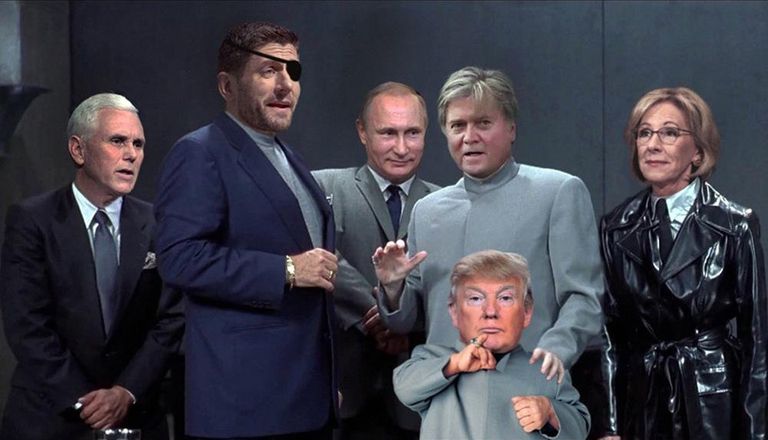
The life and times of Teeny Tiny Trump


T Tiny Trump Meets Justin Trudeau


T Tiny Trump and Putin

T Tiny Trump Throws a Tantrum


T Tiny Trump on Vacation with Obama


T Tiny Trump at Oval Office Desk


T Tiny Grumpy Trump
 

T Tiny Trump says goodbye to Justin Trudeau


T Tiny Trump out for the day with friends

 
 T Tiny Trump Selfie
    

T Tiny Trump and Melania


T Tiny Trump as Dr. Evil


T Tiny Trump at Work


T Tiny Trump on CNN


T Tiny Trump Coloring


T Tiny Trump and the Secret Service

Monday, October 30, 2017

HAPPY HALLOWEEN !!

Related image
HAVE A SAFE AND HAPPY HALLOWEEN
BOOOOOYAH!!

Thursday, October 26, 2017

Girl with cerebral palsy detained by ICE agents after surgery


A 10-year-old girl in Texas with cerebral palsy faces deportation after being discharged from a hospital where she just had surgery.
Rosamaria Hernandez, who is undocumented but has lived in the US since she was 3 months old, and her cousin were confronted around 2 a.m. Tuesday by Immigration and Customs Enforcement officers.
Rosamaria and her cousin, who is a US citizen, were in an ambulance and being transferred between two hospitals so the little girl could undergo emergency gall bladder surgery at Driscoll Children’s Hospital in Corpus Christi.
The ambulance was escorted by ICE agents to the hospital from an immigration checkpoint in Freer. Border Patrol agents waited outside the girl’s hospital room until she was released from the facility.
Upon her release, Rosamaria was taken to a shelter in San Antonio that holds migrant children who arrive alone in the US — despite doctor’s orders that she visit with her family’s primary care physician in Laredo post-surgery.
“Their orders are to process her,” said Leticia Gonzalez, who works with the girl’s immigration lawyer, Alex Galvez. “At this point, our argument to [immigration officials] is there is a doctor’s directive, why aren’t you following it?”
Rosamaria has lived in Laredo since being brought by her parents from Mexico to the US illegally as a baby.
A Customs and Border Protection spokesman said Rosamaria was no exception to the agency’s responsibility to follow immigration law.
“Per the immigration laws of the United States, once medically cleared she will be processed accordingly,” Rod Kise said in a statement. “The Mexican Consulate has been advised of the situation by Laredo Sector Border Patrol.”
Galvez said Homeland Security officials will conduct a home study to see if the girl can be released to family. He said her case will be expedited and that it’s strong because she’s not a flight risk due to her disability and doesn’t pose a threat to society.
Rosamaria’s mother, Felipa de la Cruz, said they crossed the border in hopes of getting medical treatment for her cerebral palsy. The family wasn’t able to afford therapy in Mexico but in Texas, Medicaid paid for the girl’s treatment, de la Cruz said.
“I’m a mother. All I wanted was for her to get the surgery that she needed,” de la Cruz told the New York Times. “It never crossed my mind that any of what is happening right now could happen. When you’re a mother, all you care about is your child.”
Guards outside her hospital room ?? Really?? She's ten and disabled. The poor little scrap of humanity. Whatever happened to compassion and generosity in America? Why are those guards not tracking down illegal  human traffickers and illegal drug smugglers ? Shame on you America.

Wednesday, October 25, 2017

 
Canada 


Tuesday, October 24, 2017

Jeff Flake: Republican senator quits with attack on Trump

 
A US Republican senator says he will not seek re-election, delivering a fierce attack on Donald Trump. Arizona Senator Jeff Flake said "reckless, outrageous and undignified behaviour" at the top of the US government was dangerous to democracy.
Mr Trump has previously called Mr Flake "toxic". The president is already embroiled in a row with another Republican Senator, Bob Corker.
Before confirming his decision in a speech to the Senate, Mr Flake told the Arizona Republic newspaper "there may not be a place for a Republican like me in the current Republican climate or the current Republican Party".
Taking to the floor, he said he did not enjoy criticizing the president but felt it was "a matter of duty and conscience".
"We must never regard as 'normal' the regular and casual undermining of our democratic norms and ideals," he said.
He lamented the "flagrant disregard for truth or decency, the reckless provocations, most often for the pettiest and most personal reasons".
"I have children and grandchildren to answer to, and so, Mr President, I will not be complicit," he added.
White House press secretary Sarah Sanders said it was "probably a good move" Mr Flake was standing down, suggesting he would not win re-election anyway. Jeff Flake was facing an uphill battle in his re-election campaign next year. It wasn't because the incumbent senator was matched up against a particularly tough Democrat, but rather because the Republican Party had shifted under his feet.
He found himself at odds with Donald Trump and the populist, nationalist movement that swept the president to power - and facing a right-wing challenger backed by Mr Trump's former adviser and campaign guru, Steve Bannon. So with poll numbers indicating he very well might be unceremoniously dumped from office, Mr Flake decided to go out on his own terms.
It's become almost a cliché at this point that a Republican Trump critic only finds his voice once his political career is at or near an end. Mr Flake's situation is different. His career is at an end not by his choice, but by forces outside his control. He's been an outspoken Trump critic for some time, and soon he will be out of a job.

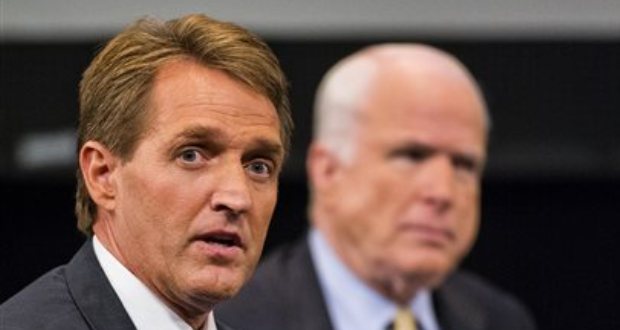
Sen. Jeff Flake, R-Ariz., left and Sen. John McCain, R-Ariz. (AP Photo/The Arizona Republic, Tom Tingle)
Another prominent party critic of Mr Trump, John McCain, was quick to pay tribute to Mr Flake.

Mr Flake has long been a vocal opponent of Mr Trump, refusing to endorse him during the presidential campaign. Although he largely voted in line with the party, his comparatively moderate views and critiques of the direction of the Republicans under Mr Trump have left him out of kilter with voters who made Mr Trump president.
For his part, Donald Trump has long wanted to oust Mr Flake, even offering to spend millions of his own money to see him unseated in primaries.


In a series of television interviews earlier in the day, Sen. Bob Corker accused the president of lying, adding that he had debased the US and weakened its global standing.
Mr Trump fired back on Twitter, calling the Tennessee senator a "lightweight" who "couldn't get re-elected". Mr Corker is also not seeking another term in elections next year. The feud overshadowed efforts by Mr Trump to build support for his proposed tax cuts.
The ongoing public feud between Corker and Trump exploded Tuesday ahead of the President's high-stakes visit to Capitol Hill for tax negotiations, with the Tennessee Republican telling CNN's Manu Raju he wouldn't support Trump for president if given the opportunity again.
The President had earlier accused Corker, who has said he will not run for re-election in 2018, of blocking his party's efforts on tax cuts.
The off-message exchange between the two men escalates a rift that has highlighted divisions between Trump and several Republican lawmakers on Capitol Hill at a critical time for his tax agenda.

Saturday, October 21, 2017

Winston Churchill's grandson called Donald Trump a 'daft twerp'

Nicolas Soames
VEUER       October 20th  
President Trump has been called a lot of names since entering office, but an English lawmaker just used a term that has the potential to become a new nickname. 

The president has been called Ignorant, mentally unstable, an orange orangutan and even a dotard by Kim Jong Un. The world is still trying to figure out exactly what that last one means. 

Now, the grandson of one of Britain’s most famous leaders has added another name to that list. 
The president tweeted Friday morning, “Just out report: “United Kingdom crime rises 13% annually amid spread of Radical Islamic terror.” Not good, we must keep America safe!” 

Winston Churchill's grandson called Donald Trump a 'daft twerp' after the US president made a comment connecting the UK's rise in crime to 'Radical Islamic terror'.

On Friday morning, Trump sent out a tweet citing new UK crime statistics and wrote that 'we must keep America safe.' 

'Just out report: "United Kingdom crime rises 13% annually amid spread of Radical Islamic terror." Not good, we must keep America safe!' he wrote.

Nicholas Soames, Winston Churchill’s grandson and conservative member of Parliament, responded writing, “then fix gun control you daft twerp.” 
The uncommon phrase had many wondering just what exactly does "daft twerp" mean?

Twerp is a pretty common schoolyard nickname, it means a silly, insignificant or annoying person, and daft is an adjective meaning silly or foolish. 

The tweet from the Churchill family member might have taken Trump by surprise since the president has mentioned in the past how much he likes Churchill. 
He’s even got a bust of the leader in the Oval Office.