Wednesday, November 18, 2015


Paris Takedown of terrorist cell - as it prepares for another attack
Abdelhami Abaaoud, the mastermind of the attacks who was believed to be in Syria, was identified as being inside the building.
Suspect Salah Abdeslam, who was the subject of an international arrest warrant after hiring a car used in the attack, was also inside.

A woman - believed to be a relative of Abaaoud - blew herself up using a suicide vest as gunfire was exchanged between the suspects and police. A second suspect was shot dead by a police sniper.
Seven people were arrested and several officers were also injured in the six-hour stand-off blocked off the area around Place Jean Jaures. Police also smashed down the doors of a nearby church as a hunt for the suspects continued.
33 ISIS militants killed in 72 hours of air strikes
A total of 33 ISIS militants are reported to have been killed in air strikes in Syria in the 72 hours of bombing by France and Russia.
The ISIS stronghold of Raqqa has seen the majority of bombing - Islamic State command and control centres, a jihadi recruitment centre, munitions depots and training camps have been among the targets.
President Francois Hollande described France as being "at war" against Islamic extremism and has vowed to destroy Islamic State.
President Francois Hollande described France as being "at war" against Islamic extremism and has vowed to destroy Islamic State.
The UK-based Syrian Observatory for Human Rights said most died when checkpoints around the city were hit.
All 129 victims identified
The French government confirms all 129 people killed in Friday's Paris attacks have been identified.
A statement released said around 100 families have come to see the bodies of those killed at the Bataclan theatre, in cafés and outside the Stade de France.
The death toll could rise if critically ill victims do not recover.

Discovery of oxygen on a comet sets back search for Earth's twin
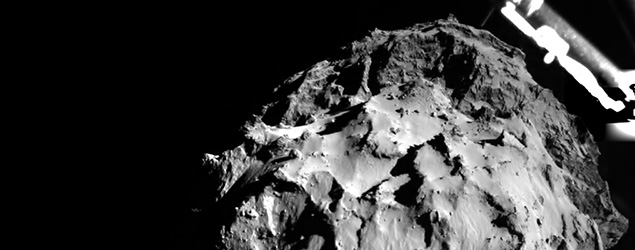
Europe’s robotic explorer Rosetta has been orbiting the four kilometre-wide Comet 67P/Churyumov–Gerasimenko for over a year and while astronomers already knew that this icy interloper and others like it harbor many of the essential chemical ingredients for life, now surprisingly it seems we can add reservoirs of oxygen to that list.
According to the new study published in the journal Nature, what makes this finding even more perplexing is that despite oxygen being a molecule that breaks down quickly, which then combines to form other chemicals, the comet’s oxygen supply may in fact be quite ancient , having formed billions of years in the past out of the same primordial cloud the Sun, Earth and all the other planets formed.
“I actually closed my eyes and said ‘this cannot be true, there must be something wrong with the instrument or the spacecraft’,” said Rosetta scientist Kathrin Altwegg and a co-author on the new study in an interview with Yahoo Canada.
Scientists had always assumed that because oxygen is so reactive it must have combined with the vast amount of hydrogen gas present at the time of the birth of the solar system and formed copious amounts of water. But now this big surprise will mean scientists have to go back to the drawing board and come up with new ideas of how the Sun, its planets and comets all got here.
“This evidence of oxygen as an ancient substance will likely discredit some theoretical models of the formation of the solar system,” says Altwegg.

The ramifications go beyond just changing what we think we know about our own solar system’s birth; it impacts our search for sister Earths too.
Altwegg and others are saying this unexpected comet finding may end up being quite a game changer in terms of our search for life beyond Earth, especially when looking on planets around distant stars.
Currently we have confirmed as of this week 1,905 exoplanets and that number is growing practically on a weekly basis now thanks to both space and ground-based survey telescopes scanning the myriad of stars for signs of orbiting worlds.
One of the holy grails in astronomy has been to identify a sister Earth – a planet that has a habitable environment and has signs of life. And researchers have come up with an ingenious way of looking for these signs.
Astronomers think that with a powerful enough telescope, they could detect currently existing life on another planet by simply analyzing the gases in their alien atmospheres and their chemical fingerprints searching for any biosignatures of life like methane, oxygen, carbon dioxide and chlorophyll – all natural indicators of the presence of life.
But in light of the discovery that biologically important gases too can exist on uninhabitable comets over astronomically long time periods, researchers may have to adjust their theories.
“In the comet I think we have all necessary compounds to start life except one, and that is energy because temperatures are way too low (-240°C) to do chemical reactions and therefore biological activity,” said Altwegg.
“However, a comet has oxygen and methane and the combination of the two are often thought to be biomarkers, signs for life and so this comet proves that this may be incorrect.”
But now that scientists know oxygen gas can exist on uninhabitable comets over astronomically long time periods, we will likely have to retool our search methods. The lesson for planet hunters appears to be that while some newly discovered small rocky worlds may at first glance appear habitable the search for a sister Earth will be more complex than we originally hoped.
Closest Earth-Size Exoplanet Found May Be a Venus Twin

One of the dire frustrations of studying planets around other stars (and, really, any astronomical object) is their distance from Earth, which makes it onerous or impossible to get many basic details about them. Exoplanets are doubly frustrating because any light they emit (light that would give hints about what's happening on the surface) is often overwhelmed by the light of the parent star.
But the new planet, called GJ 1132b, is only a cosmic stone's throw from Earth, orbiting a fairly dim star, and appears to be a rocky world with an atmosphere. And while its surface temperature indicates that it may have more in common with Venus than Earth, it is so perfectly primed for Earth-based studying, that astrophysicist Drake Deming hailed it as "arguably the most important planet ever found outside the solar system."
The significance of this new world derives from several factors. The first of those factors is its size—only 1.2 times the mass of Earth—and second is its proximity—only 39 light-years from our sun. These factors earned it the title "closest Earth-sized exoplanet yet discovered.
Our galaxy spans about 100,000 light-years. So this is definitely a very nearby solar neighborhood star.
"Our ultimate goal is to find a twin Earth, but along the way we’ve found a twin Venus," said astronomer David Charbonneau of the Harvard-Smithsonian Center for Astrophysics, in a statement. "We suspect it will have a Venus-like atmosphere too, and if it does we can’t wait to get a whiff."
While this is too high for life (as we know it) to survive, it is cool enough to potentially maintain an atmosphere. CJ 1132b is "significantly cooler than any other exoplanet confirmed to be rocky. In comparison, well-known worlds such as CoRoT-7b and Kepler-10b possess scorching temperatures of 2,000 degrees Fahrenheit or more." At those temperatures, atmospheres similar to the one on Earth or Venus rarely survive.
"If we find this pretty hot planet has managed to hang onto its atmosphere over the billions of years it’s been around, that bodes well for the long-term goal of studying cooler planets that could have life," Berta-Thompson said. "We finally have a target to point our telescopes at, and can dig much deeper into the workings of a rocky exoplanet, and what makes it tick."
Perhaps, among this population of planets, scientists will find an alien world with the right setup to support life. GJ 1132b could be an important step toward that discovery.
Honduras detains five Syrians heading for U.S. with stolen Greek passports

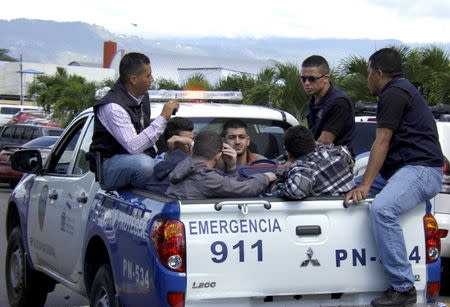
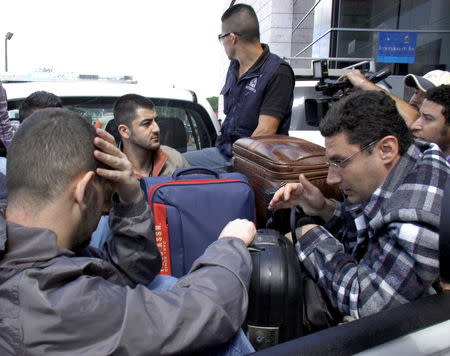
Syrian men sit in the bed of a truck after being detained at Toncontin international airport in Tegucigalpa, Honduras, November 18, 2015. Honduran authorities have detained five Syrian nationals who were trying to reach the United States using stolen Greek passports, but there are no signs of any links to last week's attacks in Paris, police said. The Syrian men were held late on Tuesday in the Honduran capital, Tegucigalpa, on arrival from Costa Rica, and had been planning to head to the border with neighboring Guatemala. The passports had been doctored to replace the photographs with those of the Syrians, police said.
Tuesday, November 17, 2015
In view of Paris attacks - 1939 invoked in debate over Syrian refugees

The recent controversy over resettling Syrian refugees on US soil has some critics drawing comparisons to the plight of Jews fleeing the Nazi Holocaust during World War 2.
Following last week's Paris attacks, numerous Republican presidential candidates have called on the Obama administration to suspend plans to issue visas to 10,000 of the millions of Syrian refugees who have fled the growing conflict in their home country.
In addition 28 states, represented by their governors, have said they will take whatever steps possible to block Syrian refugees from entering their states. Senator David Vitter, running for governor of Louisiana, released a television advertisement alleging that his Democratic opponent will allow Islamic militants to threaten their citizens.
Presidential candidates such former Florida Governor Jeb Bush and Texas Senator Ted Cruz have said the US should give preference to Christian refugees and help Muslims fleeing Syria to relocate to other Muslim nations.
Such religious discriminations, writes Janell Ross of the Washington Post, are obscene in "a country where early settlers arrived seeking riches and freedom to practise their faith".
She is one of many who have raised a Jewish Holocaust analogy.
"Just before and during World War 2, the decision to cast group suspicion on European Jews and deny most entry on the grounds that with relatives and ties to Europe they might be spies or vulnerable to forced spying helped cost innumerable lives during the Holocaust," she writes.
Several writers specifically mentioned the story of the St Louis, a cruise ship carrying more than 900 Jewish refugees from Germany that was denied entry into Cuba and then the US.
The ship was forced to return to Western Europe, where a quarter the refugees eventually died in the Holocaust.

The St Louis
David Bier of the Niskanen Center writes that in 1940 US State Department "essentially endorsed the decision to turn back the St Louis", as it recommended Caribbean nations continue to refuse entry for Jewish refugees for fears that "spies had infiltrated the refugee stream"
"The refugee has got to be checked because, unfortunately, among the refugees there are some spies, as has been found in other countries," President Franklin Roosevelt said at the time.
Others critics have drawn parallels between today's rhetoric and public sentiments expressed in the late 1930s. They cite a 1938 Fortune magazine poll asking Americans whether European political refugees should be allowed to enter the US. Nearly 70% said "with conditions as they are, we should try to keep them out". Only 5% said the US should raise immigration quotas to allow more entries.The following year, 61% of the US public said the government should not admit "10,000 refugee children from Germany - most of them Jewish".
Contrast that with comments by New Jersey Governor Chris Christie, who is also seeking the Republican presidential nomination, who said on Monday that the US should deny entry to all Syrian refugees - including orphans under the age of five until they can receive "appropriate vetting".
"Most Western countries regarded the plight of Jewish refugees with scepticism or unveiled bigotry (and sympathy only followed wider knowledge of the monstrous slaughters of the Holocaust)," the Washington Post's Ishaan Tharoor writes. "It's worth remembering this mood when thinking about the current moment, where the United States is once more in the throes of a debate over letting in refugees."

Chris Christie says Syrian orphans should not be allowed entry into the US until they can receive "appropriate vetting"
Vox's Max Fisher is more direct in his criticism of the rhetoric now dominating the Republican presidential campaign.
"American politicians are acting to punish innocent men, women and children because they fear people who are different," he tweets. "It's as if history never happened, as if we have no precedent or past we might learn from."
Ed Striker, editor of the conservative website NewsMachete, calls such historical analogies offensive.
"Jews who came to America were not themselves violent," he writes in the American Thinker. "They did not strap bombs on themselves and blow themselves up in theatres; they did not go into restaurants and execute diners, one by one; and they did not attempt to set up a caliphate wherever they moved to, although they did tend to dominate the deli, bagel-making and stand-up comedy fields."
He says Muslim refugees support sharia law and are intolerant of other religions, and a "large subset" want to kill people of other religions.
The Wall Street Journal's editors write that while the recent push to close the US border to Syrian refugees is regrettable, it's the result of Mr Obama's failure to take what they see as common-sense steps to safeguard the US against the threat of Islamic militants.

Marco Rubio compares "militant Islam" to Nazi Germany
World War 2 analogies are by no means restricted to the left, however. On Sunday Republican presidential hopeful Marco Rubio criticized Democratic front-runner Hillary Clinton for failing to say the US is "at war with radical Islam.
"I don't understand it," the Florida senator said. "That would be like saying we weren't at war with the Nazis, because we were afraid to offend some Germans who may have been members of the Nazi Party, but weren't violent themselves."
Jonathan Chait of New York Magazine says that such a metaphor implies that "the Muslim faith as a whole is equivalent to Nazism, and violent jihadi terrorists are the equivalent of the Nazi leadership."
Immigration was already a superheated topic among presidential candidates before Friday's Paris attacks. Now, however, the debate has become laced with issues of national security and morality - and allusions to a dark chapter in 20th Century history.
We are beginning to believe that this too is a dark chapter in human history. Let me count the ways.......too many to count.
"I don't understand it," the Florida senator said. "That would be like saying we weren't at war with the Nazis, because we were afraid to offend some Germans who may have been members of the Nazi Party, but weren't violent themselves."
Jonathan Chait of New York Magazine says that such a metaphor implies that "the Muslim faith as a whole is equivalent to Nazism, and violent jihadi terrorists are the equivalent of the Nazi leadership."
Immigration was already a superheated topic among presidential candidates before Friday's Paris attacks. Now, however, the debate has become laced with issues of national security and morality - and allusions to a dark chapter in 20th Century history.
We are beginning to believe that this too is a dark chapter in human history. Let me count the ways.......too many to count.
"They have the weapons. Screw them. We have the champagne!"

The upcoming Charlie Hedbo satirical magazine is expected to hit newsstands Wednesday. The cover reads: "They have the weapons. Screw them. We have the champagne!" The magazine's office was the target of a terror attack in July. I don't possess that wonderful French insouciance that I so admire, so I quote Shakespeare:
What stronger breast-plate than a heart untainted ? Thrice is he arm'd that hath his quarrel just - 'Vive la France'!
Subscribe to:
Posts (Atom)