Sunday, March 23, 2014

I Kept My Promise


Clearing in the woods
 I Kept My Promise

I welcome the embrace of the cool, emerald green.
Rustling trees surround me with lacy ferns between,
And mossy stones enclose the glade in the woodland ravine,
Where yellow blossoms nod their heads, so gentle, so serene.

 I knew I'd sense your presence; your love was always strong.
You've been waiting for me here and the winter was so long.
Now, rest among the flowers in the sunshine and birdsong.
This enchanted, gilded circle is just where you belong.

 The day is warm and tranquil; I'll spend it here with you,
And contemplate the artistry of the sky's cerulean blue,
Watch sunlight on the petals make jewels of morning dew,
 And on the rainbow wings of dragonflies, darting into view.

 We'll discuss philosophy; your wisdom was so true.
I'll ask you why you went away, you left us all too soon.
You had a vital spirit, and still had life, unlived.
So many words were left unsaid and you had so much more to give.

 I see the sun is waning, I must say adieu.
The peaceful green has cast it's spell and I am renewed.
I have kept my promise to you, to come here and commune.
Each spring, I shall remember you when the daffodils bloom.


 From the Genie ...to her father

Saturday, March 22, 2014

Rare Type of Meteorite Lands in Southern Ontario


Canadian and NASA researchers believe one or more fragments of a rare and valuable meteorite may have landed near St. Thomas, Ont., after a fireball streaked across the sky in southern Ontario Tuesday night.

"This is very exciting for us," said Western University meteor physicist Peter Brown at a news conference Friday, where he appealed to the public for help in finding the meteorite fragment or fragments.
Meteors are fragments of asteroids or comets that fall through the Earth's atmosphere, where they burn up, producing a bright light. Fireballs are meteors that appear brighter than the planet Venus, and are typically from larger space rocks.
Tuesday night's fireball first appeared in the sky at 10:45 p.m. about 75 kilometres above Port Dover, Ont., and headed almost due west before vanishing at an altitude of 32 kilometres between Aylmer and St. Thomas. It widely seen in Toronto, Hamilton, London and other parts of southern Ontario, where skies were clear.
Brown, director of Western's Centre for Planetary Science and Exploration, estimated the space rock was originally the size of a basketball. His colleague, Western University meteorite curator Phil McCausland, said one or more fragments "about the size of a golf ball or baseball" likely landed about five kilometres north or northwest of St. Thomas.
The meteorite from this event is particularly rare and valuable to science because the fireball was captured by seven all-sky cameras of Western's Southern Ontario Meteor Network, allowing researchers to calculate its orbit – something that has only been possible for about 20 other meteorites in the past.
"Each one of those is like a Rosetta stone," Brown said, referring to a famous Egyptian artifact that was a key to deciphering ancient Egyptian hieroglyphics.
Not only was there good data on the space rock's orbit, but that orbit itself was special. It turns out the rock has spent most of its recent past circling closer to the sun than the Earth, having left its original orbit in the asteroid belt between Mars and Jupiter long ago.
Bill Cooke, head of NASA's meteoroid environment office, said only one other meteorite known to have come from that kind of orbit has ever been recorded.
"This is not your run-of-the-mill meteor fall," he said at the news conference. "This is a very unusual orbit. We're really interested in knowing what type of object was in this … We won't know that until we find a piece of it."
Brown said the meteorite is a piece of the early solar system.
"This is like a poor man's space probe. It comes to us," he said. "It's going to tell us … what made the Earth, what made the other planets."
Brown is asking for the public to help look for the meteorite – described as a rock that looks like it was painted black – and contact the researchers if they find it.
The researchers are also interested in hearing accounts from anyone who may have heard a whistling sound "like artillery coming in" or a thud after witnessing the fireball, indicating that it may have landed within a few hundred metres. That may help narrow down the area for the search.
Brown noted that it's the first time in five years that such a meteor fall has taken place in southern Ontario. The last time researchers issued a callout like this, the meteorite was recovered days later by a member of the public near Grimsby, Ont., where it had crashed through the windshield of an SUV.

In Concert "Bee Gees" One Night Only


How Earth Avoided a Solar Catastrophe


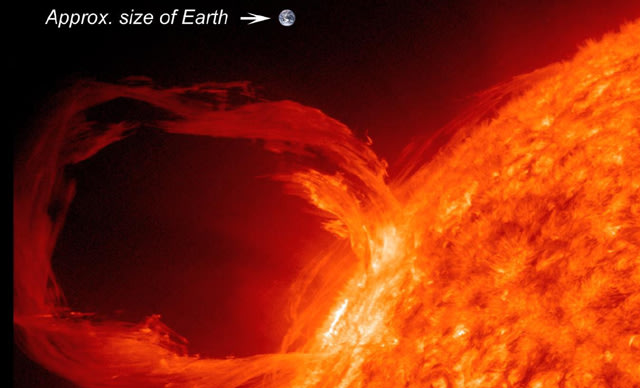
In the summer of 2012, when all the hype about the supposed Dec. 21 Mayan Apocalypse was really starting to kick into high-gear, it seems that we only barely avoided a real catastrophe, when three solar eruptions in late July combined to produce a solar storm that could have caused chaos if it had hit Earth.

As scientists monitor the sun for any potentially-dangerous space weather events, it's typically the most powerful solar flares — the X-class flares — that get the most attention. These are the ones that throw off powerful blasts of high-energy particles, as well as immense coronal mass ejections which can cause intense geomagnetic storms when they impact on Earth's magnetic field. Both of these effects can take a toll on our technologies, especially on orbiting satellites and spacecraft, but also on power grids and electronics on the Earth's surface.


One of the most famous of these events, known as the Carrington Event, happened in early September 1859, when a solar flare blasted out from the sun that scientists estimate was an X45-class (when the scale of the different levels, C, M and X are typically ranked from 0-9). It was the most powerful solar flare ever recorded. It caused highly-active auroras that extended much farther away from the polar regions than they they usually do, and it disrupted telegraph service across Europe and North America, with some telegraph operators actually getting shocks from their equipment due to the charge the solar storm induced along the telegraph lines.


However, although these really big flares are definitely a threat to us, a new study is saying that we have to start looking at smaller solar flares as potentially being bigger threats, because their effects can combine together to produce something approaching a Carrington-level event. This isn't just speculation or modeling on the researcher's part, though. Such an event happened in July 2012, but it managed to miss Earth by 9 days. That may seem like a pretty wide margin, but 9 days represents only 2.5 per cent of our year, which is cutting it really close.
"Had it hit Earth, it probably would have been like the big one in 1859, but the effect today, with our modern technologies, would have been tremendous," said study co-author Janet Luhmann, a UC Berkeley physicist who is part of the team that works with the Solar Terrestrial Relations Observatory that detects these eruptions, in a statement.
A study from 2011 estimated that if a similar event were to happen today, the total cost of the damages could reach between $1 trillion and $2 trillion, and the effects of the satellite losses and power grid failures could be felt for years after.
It all started on July 19, 2012, when an M7.7-class flare blasted out from the sun's surface, just as the sunspot where it originated from passed beyond our view of it, as seen in this video from NASA's Solar Dynamics Observatory.

The coronal mass ejection (CME) that resulted from this flare blasted out from the sun, sweeping a wide swath of the inner solar system clear of particles and matter from the solar wind that typically acts to slow these eruptions down as they travel through space.
Then, before that space could fill up again, two more solar flares went off on July 23rd, just 10 to 15 minutes apart from one another, as shown in this video:

The coronal mass ejections from these two flares weren't too powerful when each was taken on its own, but being so close together, they slammed into one another and merged to form one, much more intense, CME. Thanks to the effect of the one from July 19, this combined CME became one of the fastest ever recorded, travelling at over 10.5 million kilometres per hour (a simulation of this is shown at 23 seconds into the video).
The STEREO-A satellite, which circles the sun in the same orbit as Earth, but leading us by an ever-increasing amount of time, was in the direct path of this CME and recorded its effects:

The 'snow storm' seen at the end of the video is due to the camera being hit by high-energy particles from the solar eruption.
The threat here comes from the fact that, although X-class flares only happen once in a while (even during solar maximum), these M-class flares happen much more often. This increases the chance that we'll be hit by these combined CMEs.
"People keep saying that these are rare natural hazards, but they are happening in the solar system even though we don’t always see them," Luhmann said in the statement. "It's like with earthquakes — it is hard to impress upon people the importance of preparing unless you suffer a magnitude 9 earthquake."
Other researchers agree with her. Back in December of last year, Daniel Baker, the director of the University of Colorado-Boulder's Laboratory for Atmospheric and Space Physics, said in a press release that this event should be taken as a new best estimate of a worst case scenario, but he and his colleagues believe that policymakers are not going to pay attention to these events until we're hit by a really big one.
"The Carrington storm and the 2012 event show that extreme space weather events can happen even during a modest solar cycle like the one presently underway," he said in the statement. "Rather than wait and pick up the pieces, we ought to take lessons from these events to prepare ourselves for inevitable future solar storms."
How can we protect ourselves from these storms? There's no way to avoid one if it's on the way towards us, but we can manage things here on the ground to lessen or avoid the impact, mainly by strengthening our power grid and developing effective forecasting systems that would let us take vulnerable 'nodes' of a grid offline until the storm passed. NASA's 'Solar Shield' project has been looking at this for a few years, and other scientists have been researching how the Earth itself protects us from these effects.

Friday, March 21, 2014

Pope Francis denounces 'evil, blood-stained' mafia

Pope Francis after leading an audience with the family members of victims of the mafia at the San Gregorio VII church in Rome (21 March 2014)

The pope was uncompromising in his criticism of the mafia as he met family members bereaved by organized crime 

Pope Francis has launched a stinging attack on the mafia, warning gangsters that they will go to hell unless they repent and stop doing evil.

"Blood-stained money, blood-stained power, you can't bring it with you to your next life. Repent," he said.
He was speaking at a prayer vigil for relatives of those killed by the mafia.The Pope has spoken out frequently about the evils of corruption and wrote a booklet on the subject in 2005 when he was archbishop of Buenos Aires.
The meeting near Rome on Friday - organized by a citizens' group called Libera - was aimed at demonstrating the Roman Catholic Church's opposition to organized crime, rejecting historic ties with mafia bosses claiming to be good Catholics.

Pope Francis (right) leaves the church in Rome with Father Luigi Ciotti of the Catholic Libera association
The vigil is held every year, but this was the first time that it was attended by the pope

Pope Francis delivers his speech during a meeting with relatives of innocent mafia victims
The pope told told Italy's mobsters to relinquish their 'blood-stained money' which 'cannot be taken into paradise'

Pope Francis greets the faithful as he leaves at the end of a meeting with relatives of innocent mafia victims
More than 1,000 people attended prayers with the pope at a church near the Vatican

Pope Francis (centre right) attends the service

 The meeting was an attempt to draw a line under the church's historic ties with mafia dons claiming to be God-fearing Roman Catholics. The vigil was filled with those who have suffered at the hands of the mafia, including people whose family members and loved ones had been killed. As the names of those murdered were read out, the Pope listened, deep in sombre thought.
After expressing solidarity with the 842 people at the vigil, he said that he could not leave the service without addressing those not present: The "protagonists" of mafia violence.
"This life that you live now won't give you pleasure. It won't give you joy or happiness," he said.
"There's still time to not end up in hell, which is what awaits you if you continue on this path."
 There is a long list of brave priests in Italy who have stood up to the mafia, and some have paid with lives. But the broader  institute of the Vatican has been accused of not doing enough to confront the gangsters. Anti-mafia activists hope that the Pope's words are a signal that he is on their side and perhaps the Vatican will play a bigger role in the future. Bravo, Pope Francis, for speaking out

New Dinosaur Species Discovered...Chicken From Hell


US scientists have announced the discovery of a new species of dinosaur. Its fossils offer further clues to how the dinosaurs became extinct 66 million years ago. Anzu wyliei is a strange, bird-like creature that has a bony crest on top of a beaky head and a long tail like a lizard. The animal was identified from the partial remains of three skeletons collected in North and South Dakota. It is reported in PLoS ONE journal.

 "We had inklings that there might be such a creature out there, but now with these bones we have 80% of the skeleton and can really look in detail at the structure of this animal and make inferences about its biology," says Hans Sues, curator of vertebrate palaeontology in the department of palaeobiology at the Smithsonian's National Museum of Natural History in Washington DC.

"Anzu is really bizarre, even by dinosaur standards. The skull has this extraordinarily tall and thin crest with a snout and a huge beak with sharp edges and a strange sliding jaw joint, that could be used to cut up vegetation and meat".
The size of a small car, the dinosaur also had claws and feathers on its upper arms. It belongs to a group of dinosaurs known as Oviraptorosauria. Most evidence of their existence comes from fossils discovered in Central and East Asia. The Anzu bones are the first detailed evidence that oviraptorosaurs also lived in North America.
The specimens were found in a geological formation known as Hell Creek, which has been extensively explored and is the source of many dinosaur fossils discovered in North America.

Scientists have nicknamed it "the chicken from Hell" because of its appearance and where it was found.
The site is important because it was formed in the last two million years of the Cretaceous Period, just before dinosaurs were wiped out by an asteroid strike. Many researchers have argued that the dinosaurs were already in decline because of climate change. But according to Dr Sues and his team, the discovery of Anzu offers further proof that many species were still evolving and dinosaur communities were diverse and flourishing.

Skull
The Anzu wyliei skull, shown in a reconstruction, featured a bony crest
"This is consistent with the idea that a mass extinction was caused by the great asteroid impact 66 million years ago. It's clear that dinosaurs were still quite diverse until the very end," says Dr Sues.

A thousand species of dinosaurs have been discovered so far. Scientists believe there are many thousands more waiting to be identified, even in heavily excavated formations such as Hell Creek.
The discovery of another species from the site was announced in December last year - a small raptor called Acheroraptor temertyorum. And scientists have only begun to explore potential dinosaur graves in Central Asia. 
But there's no magic formula for discovery, according to Tyler Lyson, who found one of the Anzu skeletons in 2009 on his uncle's ranch in North Dakota.

"We were just walking along when we saw some dinosaur bones poking out of the ground," he recalls.
"I knew right away that they belonged to a meat-eating dinosaur because meat-eating dinosaurs have hollow bones, and these bones were hollow. We carefully made a plaster jacket to wrap the specimen and get it back to the lab. After several hours cleaning it, we knew we had found something new. It was unlike anything else we had ever seen before."
Dr Lyson is part of the Smithsonian team and the founder of the Marmarth Research Foundation, which promotes the study of fossils. He discovered his first dinosaur bone when he was just six years old.
The other two Anzu skeletons, which include a skull, were discovered by private collectors.
"You just have to spend time out there," he says. "The bones come to the surface and then break up into little pieces. You get a trail of broken bits of bone which you follow, and if you're lucky you'll see bones sticking out of the side of the hill - and that's exactly what we found here."

Although the Anzu skeletons were discovered several years ago, scientists work in "deep time", says
Dr Lyson. Bones have to be catalogued and compared with other specimens while scientific evidence has to be peer-reviewed. It can take a decade before any official announcement is made. All three Anzu skeletons are housed at the Carnegie Museum of Natural History in Pittsburgh, which collaborated with the Smithsonian to identify the new species.

Definitive Proof of the Big Bang and Inflation of the Universe

BICEP2
The measurements were taken using the BICEP2 instrument at the South Pole Telescope facility

 Scientists say they have extraordinary new evidence to support a Big Bang Theory for the origin of the Universe. Researchers believe they have found the signal left in the sky by the super-rapid expansion of space that must have occurred just fractions of a second after everything came into being. It takes the form of a distinctive twist in the oldest light detectable with telescopes. The work will be scrutinized carefully, but already there is talk of a Nobel.

"This is spectacular," commented Prof Marc Kamionkowski, from Johns Hopkins University."I've seen the research; the arguments are persuasive, and the scientists involved are among the most careful and conservative people I know," he said.
The breakthrough was announced by an American team working on a project known as BICEP2.

This has been using a telescope at the South Pole to make detailed observations of a small patch of sky. The aim has been to try to find a residual marker for "inflation" - the idea that the cosmos experienced an exponential growth spurt in its first trillionth, of a trillionth of a trillionth of a second.

BICEP data
  Gravitational waves from inflation put a distinctive twist pattern in the polarisation of the CMB (Cosmic Microwave Background)

Theory holds that this would have taken the infant Universe from something unimaginably small to something about the size of a marble. Space has continued to expand for the nearly 14 billion years since.

Inflation was first proposed in the early 1980s to explain some aspects of Big Bang Theory that appeared to not quite add up, such as why deep space looks broadly the same on all sides of the sky.The contention was that a very rapid expansion early on could have smoothed out any unevenness.
But inflation came with a very specific prediction - that it would be associated with waves of gravitational energy, and that these ripples in the fabric of space would leave an indelible mark on the oldest light in the sky - The CMB,  the famous Cosmic Microwave Background.
The BICEP2 team says it has now identified that signal. Scientists call it B-mode polarization. It is a characteristic twist in the directional properties of the CMB. Only the gravitational waves moving through the Universe in its inflationary phase could have produced such a marker. It is a true "smoking gun".

Speaking at the press conference to announce the results, Prof John Kovac of the Harvard-Smithsonian Center for Astrophysics, and a leader of the BICEP2 collaboration, said: "This is opening a window on what we believe to be a new regime of physics - the physics of what happened in the first unbelievably tiny fraction of a second in the Universe."
The signal is reported to be quite a bit stronger than many scientists had dared hope. This simplifies matters, say experts. It means the more exotic models for how inflation worked are no longer tenable.

The results also constrain the energies involved - at 10,000 trillion gigaelectronvolts. This is consistent with ideas for what is termed Grand Unified Theory, the realm where particle physicists believe three of the four fundamental forces in nature can be tied together.


Prof Alan Guth: "Experiment is Nobel Prize worthy"

But by associating gravitational waves with the Big Bang and universal inflation, scientists are improving their prospects of one day pulling the fourth force - gravity itself - into a Theory of Everything.

The sensational nature of the discovery means the BICEP2 data will be subjected to intense peer review. It is possible for the interaction of CMB light with dust in our galaxy to produce a similar effect, but the BICEP2 group says it has carefully checked its data over the past three years to rule out such a possibility.

Other experiments will now race to try to replicate the findings. Prof Andrew Jaffe from Imperial College London, UK, works on a rival telescope called POLARBEAR. He commented: "A lot of this is technology driven. And the next generation of experiments, like the next generation of POLARBEAR, SPIDER and EBEX, will have far more detectors and will go after this signal and hopefully drag out much more detail."


Assuming the BICEP2 results are confirmed, a Nobel Prize seems assured. Who this would go to is difficult to say, but leading figures on the BICEP2 project and the people who first formulated inflationary theory would be in the running. One of those pioneers, Prof Alan Guth from the Massachusetts Institute of Technology, said "I have been completely astounded. I never believed when we started that anybody would ever measure the non-uniformities of the CMB, let alone the polarization, which is now what we are seeing.

"I think it is absolutely amazing that it can be measured and also absolutely amazing that it can agree so well with inflation and also the simplest models of inflation - nature did not have to be so kind and the theory didn't have to be right, but it was."

Scientist Dr Jo Dunkley, who has been searching through data from the European Planck space telescope for a B-mode signal, commented: "I can't tell you how exciting this is. Inflation sounds like a crazy idea, but everything that is important, everything we see today - the galaxies, the stars, the planets - was imprinted at that moment, in less than a trillionth of a second. If this is confirmed, it's huge."

Big Bang Theory conceptual artwork
"Everything we see today - the galaxies, the stars, the planets - was imprinted at that moment"