Monday, March 10, 2014

Post Mortem Evidence Nauseates Pistorius


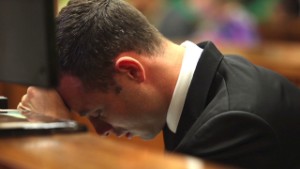
Physically sick: Oscar Pistorius vomits into a bucket as the pathologist who carried out the post-mortem on Reeva Steenkamp gave a graphic account of her injuries
Pistorius covers his head with a handkerchief
Olympic and Paralympic track star Oscar Pistorius reacts in the dock during his trial for the murder of his girlfriend Reeva Steenkamp
Inconsolable: In between bouts of sobbing and retching, Pistorius sat with his head bowed, covering his ears with his hands and a white handkerchief in an attempt to block out testimony about the post-mortem
Grief: Pistorius weeps during harrowing testimony about the extent of Miss Steenkamp's injuries

In despair: Oscar Pistorius breaks down in court as he listens to graphic evidence of Reeva Steenkamp's injuries by pathologist who carried out her port-mortem
Strain: The judge had earlier banned live broadcasting and tweeting of evidence by Prof Saayman because of the graphic nature of his evidence
An emotional Oscar Pistorius became physically sick in court on Monday as he listened to harrowing testimony about the autopsy of his girlfriend Reeva Steenkamp, whom he is accused of murdering
Sitting in the dock, the visibly shaken Paralympian retched and heaved into a blue bucket as a pathologist gave a detailed post-mortem account of the multiple bullet wounds Pistorius admits inflicting.
University of Pretoria pathologist Gert Saayman said the double-amputee sprinter shot Steenkamp with "Black Talon" hollow-point bullets, which mushroom open like a jagged flower on contact to cause maximum tissue damage. Pistorius, 27, says he fired four shots at Steenkamp on February 14, 2013 through a locked toilet door, believing her to be an intruder. He denies intentionally killing her.

Saayman -- whose testimony the media has been banned from directly reporting -- told the court how Steenkamp was struck four times with three bullets from Pistorius's nine millimetre pistol. Steenkamp was hit once in the top right of her head, once in the right elbow and once in the right hip. She was also struck in the webbing of her left hand. The 29-year-old model and law graduate also sustained injuries from bone fragments, bullet fragments and fragments of the wooden door. The pathologist said Steenkamp could have died from either of the wounds to her arm and hip. After being shot in the head, she would not have been able to breathe more than a few times and would likely have fallen unconscious, said the pathologist.  He also revealed that Steenkamp probably ate two hours before her death, seemingly contradicting Pistorius's account that the two went to bed at 10:00 pm.


Pistorius broke down as he listened to the nature of his girlfriend's injuries, retching loudly and his shoulders visibly shaking. The court briefly adjourned to allow the athlete to recover.
"Mr Roux, can you just attend to the accused, not sure what's happening?" Judge Thokozile Masipa said, addressing Pistorius's lawyer.
In the public gallery Pistorius's aunt Lois took off her glasses, closing her eyes for an extended period. His coach Ampie Louw sat still staring at Saayman, as the sound of vomiting continued.
When the court session finished for the day, Pistorius remained bent over in the dock. His older brother Carl and younger sister Aimee comforted him as he tried to regain his composure.
Some 10 minutes later, the runner's sister took him by the arm and led him out of the courtroom.

Judge Masipa earlier upheld a request from the prosecution, defence and the witness not to allow live audio broadcast of the post-mortem testimony because of its graphic content.
"There shall be no live broadcast of the evidence of Professor Saayman," Masipa ruled. "That applies to Twitter also."
Blog posts were also banned. Professor Saayman earlier asked that his testimony not be broadcast for ethical reasons. He said the graphic nature of the autopsy report may infringe on Steenkamp's dignity and harm unsuspecting members of the public who saw or heard the testimony.
"I think that it goes against the good morals of society for us to make information of this nature available in a manner that vulnerable or unsuspecting people in society may be exposed," Saayman told the court. Media outlets earlier won unprecedented rights to broadcast on television large chunks of the court proceedings, while audio of the entire high-profile trial was initially allowed throughout.

The defence is expected to argue that the first shots were fatal, making it impossible for witnesses to have heard Steenkamp scream as they claim. Earlier in Monday's hearing, Pistorius's defence sought to undermine the state's assertion that the sporting hero told a security guard "everything was fine" after he shot his girlfriend.

Last week, in testimony that cast doubt on Pistorius's claims of a "tragic accident," security guard Pieter Baba told the court that after he was informed that gunshots were heard coming from the runner's house, he phoned Pistorius, who told him "everything is fine".
But Pistorius's lawyer Barry Roux argued it was his client who phoned security first and his actual words were "I'm okay".
"I prove to you the fact was Pistorius phoned first and you returned that call very shortly," said Roux.
But Baba, wearing an orange plaid shirt, stuck to his version of events, insisting that "Mr Pistorius told me that everything is fine".
Have you drawn any conclusions yet? Hold off until you hear all the evidence. You may be surprised at the outcome; you might even be outraged. 

Senior Moments


Top

I was turned down as Fire Warden at my Nursing Home today. They asked me "What steps would I take in case of a fire?" Apparently, "Big Frickin' Ones" wasn't the correct answer.


Photo: Lol...funny!

One of my favorite jokes...

An elderly man, from Georgia, was going up to bed, when his wife told him that he'd left the light on in the garden shed, which she could see from the bedroom window. He opened the back door to go turn off the light, but saw that there were people in the shed stealing things. He phoned the police, who asked "Is someone in your house?" He said "No," but some people are ...
breaking into my garden shed and stealing from me. Then the police dispatcher said "All patrols are busy. You should lock your doors and an officer will be along when one is available." The old guy said, "Okay." He hung up the phone and counted to 30.

Then he phoned the police again. "Hello, I just called you a few seconds ago because there were people stealing things from my shed. Well, you don't have to worry about them now because I just shot them." and he hung up.

Within five minutes, six Police Cars, a SWAT Team, a Helicopter, two Fire Trucks, a Paramedic, and an Ambulance showed up at the residence, and caught the burglars red-handed. One of the Policemen said to old guy, "I thought you said that you'd shot them!" The wise old man said, "I thought you said there was nobody available!"

Photo


Photo


I can't believe all those years of phone sex have finally caught up with me. I now have hearing AIDS.


Photo: Lmao 
**A Mommy's Perception**


An old geezer stumbles up to the only other patron in a bar and asks if he could buy him a drink. "Why of course," comes the reply.
The first man then asks: "Where are you from?"... "I'm from Ireland," replies the second man.
The first man responds: "You don't say, I'm from Ireland too! Let's have another round to Ireland."
"Of Course," replies the second man.
Curious, the first man then asks: "Wh...ere in Ireland are you from?"
"Dublin," comes the reply. "I can't believe it," says the first man. "I'm from Dublin too! Let's have another drink to Dublin."
"Of course," replies the second man.
Curiosity again strikes and the first man asks: "What school did you go to?"
"Saint Mary's," replies the second man. "I graduated in '59." 
"This is unbelievable!" the first man says. "I went to Saint Mary's and I graduated in '59, too!"
About that time in comes one of the regulars and sits down at the bar. "What's been going on?" he asks the bartender.
"Nothing much," replies the bartender. "The old O'Malley twins are drunk again."


I'm reaching out on behalf of a golf buddy of mine who needs some help! His wife told him to go out and get some of those pills that would help him get an erection. When he came back, he handed her some diet pills.
Anyway, he's looking for a place to live now. Let me know if anyone can help?


Photo


A man and woman had been married for more than 60 years. They had shared everything. They had talked about everything. They had kept no secrets from each other except that the little old woman had a shoe box in the top of her closet that sh...e had cautioned her husband never to open or ask her about.
For all of these years, he had never thought about the box, but one day the little old woman got very sick and the doctor said she would not recover. In trying to sort out their affairs, the little old man took down the shoe box and took it to his wife's bedside. She agreed that it was time that he should know what was in the box. When he opened it, he found two crocheted dolls and a stack of money totaling $95,000.
He asked her about the contents.
 'When we were to be married,' she said,' my grandmother told me the secret of a happy marriage was to never argue. She told me that if I ever got angry with you, I should just keep quiet and crochet a doll.'
The little old man was so moved; he had to fight back tears. Only two Precious dolls were in the box. She had only been angry with him two Times in all those years of living and loving. He almost burst with Happiness.
'Honey,' he said, 'that explains the doll, but what about all of this money? Where did it come from?'
'Oh,' she said, 'that's the money I made from selling the dolls.'


Photo: One of my favorite cartoonists, Tim Whyatt: http://www.whyatt.com.au

Photo: That's All Folks

Mysterious New Man-made Gases a Threat to the Ozone Layer

ozone hole
Dealing with the hole in the ozone layer has been one of the most successful international science projects

Scientists have identified four new man-made gases that are contributing to the depletion of the ozone layer. Two of the gases are accumulating at a rate that is causing concern among researchers.

Worries over the growing ozone hole have seen the production of chlorofluorocarbon (CFC) gases restricted since the mid 1980s. But the precise origin of these new, similar substances remains a mystery, say scientists.

Lying in the atmosphere, between 15 and 30km above the surface of the Earth, the ozone layer plays a critical role in blocking harmful UV rays, which cause cancers in humans and reproductive problems in animals.

Scientists from the British Antarctic Survey were the first to discover a huge "hole" in the ozone over Antarctica in 1985. The evidence quickly pointed to CFC gases, which were invented in the 1920s, and were widely used in refrigeration and as aerosol propellants in products like hairsprays and deodorants.

Remarkably, global action was rapidly agreed to tackle CFCs and the Montreal Protocol to limit these substances came into being in 1987. A total global ban on production came into force in 2010.

Now, researchers from the University of East Anglia have discovered evidence of four new gases that can destroy ozone and are getting into the atmosphere from as yet unidentified sources.

Halley
The Halley Research Station in Antarctica, where the hole in the ozone layer was first discovered

Three of the gases are CFCs and one is a hydrochlorofluorocarbon (HCFC), which can also damage ozone.

"Our research has shown four gases that were not around in the atmosphere at all until the 1960s which suggests they are man-made," said lead researcher Dr Johannes Laube.

The scientists discovered the gases by analyzing polar firm, perennial snow pack. Air extracted from this snow is a natural archive of what was in the atmosphere up to 100 years ago.
The researchers also looked at modern air samples, collected at remote Cape Grim in Tasmania.
They estimate that about 74,000 tons of these gases have been released into the atmosphere. Two
of the gases are accumulating at significant rates.

"The identification of these four new gases is very worrying as they will contribute to the destruction of the ozone layer," said Dr Laube.

"We don't know where the new gases are being emitted from and this should be investigated. Possible sources include feedstock chemicals for insecticide production and solvents for cleaning electronic components."

"What's more, the three CFCs are being destroyed very slowly in the atmosphere - so even if emissions were to stop immediately, they will still be around for many decades to come," he added.


Other scientists acknowledged that while the current concentrations of these gases are small and they don't present an immediate concern, work would have to be done to identify their origin.

"This paper highlights that ozone depletion is not yet yesterday's story," said Prof Piers Forster, from the University of Leeds.

"The concentrations found in this study are tiny. Nevertheless, this paper reminds us we need to be vigilant and continually monitor the atmosphere for even small amounts of these gases creeping up, either through accidental or unplanned emissions.

"Of the four species identified, CFC-113a seems the most worrying as there is a very small but growing emission source somewhere, maybe from agricultural insecticides. We should find it and take it out of production."


Mysterious gases
  • The four new gases have been identified as CFC-112, CFC112a, CFC-113a, HCFC-133a
  • CFC-113a has been listed as an "agrochemical intermediate for the manufacture of pyrethroids", a type of insecticide once widely used in agriculture
  • CFC-113a and HCFC-133a are intermediaries in the production of widely used refrigerants
  • CFC-112 and 112a may have been used in the production of solvents used to clean electrical components

Saturday, March 08, 2014

Oil slick spotted in sea in search for missing Malaysian plane

Vietnam air force planes spot two oil slicks suspected to be from missing Malaysian Boeing 777 jet. New revelation....at least two passengers were travelling on stolen passports

Ahmad Jauhari Yahya, the chief executive of Malaysia Airlines, said there was no indication that the pilots had sent a distress signal, suggesting that whatever happened to the plane occurred quickly and possibly catastrophically.               
"We have no information on the location of the aircraft," said Malaysia Airlines in a statement. "We are currently working with international authorities on the search and rescue mission."


 The last reported position of Malaysian Airlines flight
The search has focused on an area of the South China Sea roughly 120 nautical miles south west of Vietnam - the last point of contact with the jet, and where the oil slick has been reported.  China, Vietnam, Malaysia and the Philippines all dispatched rescue ships and an emergency rescue message also alerted all ships in the region to assist the mission and watch for any survivors that might be adrift.  The Pentagon dispatched a naval destroyer and a surveillance plane to aid in the search. The US military statement said a P-3C Orion reconnaissance plane also will depart shortly from Kadena Air Base in Okinawa, Japan
The flight, a codeshare with China Southern airlines, had 153 Chinese on board, including one child. There were also five Indians, four French, three US citizens, two passengers each from New Zealand, Ukraine, and Canada, and one each from Russia, Italy, the Netherlands and Austria, but no British passengers.  Among the Chinese were two groups, one of artists and their families, who had taken part in a cultural exchange and another of Buddhists returning from a religious meeting in the Malaysian capital. 
Relatives of the passengers were directed by the Chinese police to the Lido Hotel in Beijing where they waited for news in a large conference room.  Angry relatives accused the airline of keeping them in the dark and failing to provide updates as they were received.  About 20 people stormed out of the room at one point, enraged they had been given no information. 
"There's no one from the company here, we can't find a single person. They've just shut us in this room and told us to wait," said one middle-aged man, who declined to give his name.
"We want someone to show their face. They haven't even given us the passenger list," he said.


A woman cries in Beijing airport as she waits to hear information about her family (Reuters)

However, in Europe, news reports and officials said at least two people on board may have been carrying stolen passports.   The Italian foreign ministry said in Rome that an Italian was listed on the flight's manifest although no national from the country was on board.  The passenger list provided by the airline includes Luigi Maraldi, 37, an Italian citizen. Newspaper Corriere Della Sera reported that Maraldi's passport was stolen in Thailand last August. The Italian Interior Ministry was unable to immediately comment on the report. 
In Vienna, the Austrian foreign ministry said an Austrian listed among the passengers was safe and had reported his passport stolen two years ago while he was travelling in Thailand.  Asked for a possible explanation for the plane's disappearance, Malaysia Airlines CEO Ahmad Jauhari Yahya told a news conference: "We are not ruling out any possibilities."


The Malaysia Airlines Boeing 777-200ER that went missing
 
Hishamuddin Hussein, Malaysian transport minister, said it was too early to confirm a crash and that there were no signs of wreckage on the surface of the water. 
"We are doing everything in our power to locate the plane. We are doing everything we can to ensure every possible angle has been addressed," he said.
Flight MH370, a Boeing 777-200 jet, took off from Kuala Lumpur at 12.35am on Saturday. Two hours later, according to Malaysia Airlines, it lost contact with the air traffic control in Vietnam.
 
Family and friends waiting for the plane to arrive break down as they hear the jet has gone missing (AFP)

The last data from the plane showed it climbing steadily to 35,000 ft before vanishing. There was no distress signal and the weather conditions were good.  Vietnam authorities said contact with Flight MH370 was lost near its airspace, but its exact location and fate remained a mystery for more than 12 hours after it slipped off air-traffic control screens. 
In Beijing, the Chinese president Xi Jinping ordered all resources to be mobilized to find the plane and aid survivors. Frustrated relatives struggled to make sense of the disappearance of the Boeing 777-200 which - like the Malaysian national carrier - has a solid safety record.  Malaysia Airlines said the plane, on an overnight flight from Kuala Lumpur to Beijing, relayed no distress signal, indications of rough weather, or other signs of trouble. 
If confirmed, the crash would be the worst disaster in the history of Malaysia Airlines, which has had no major accidents for almost two decades. The Boeing 777 is also one of the world's safest planes: the first fatal crash in its history only came last July when an Asiana Airlines jet landed short of the runway in San Francisco, killing three of the 307 people on board.
The worst has already been assumed by those following the story and very likely by aviation experts also. The plane was flying over water when last heard from and oil slicks, consistent with jet fuel, have been located at the point of last contact.  Sabotage is certainly a possibility.

Friday, March 07, 2014

Pistorious Breaks Down at Trial

Oscar Pistorius covers his ears on Thursday, March 6, the fourth day of his trial in Pretoria, South Africa, as a witness speaks about the morning his girlfriend Reeva Steenkamp was shot and killed. Pistorius, the first amputee to compete in the Olympics, is accused of murdering his girlfriend on February 14, 2013.

Oscar Pistorius covers his ears on Thursday, March 6, the fourth day of his trial in Pretoria, South Africa, as a witness speaks about the morning his girlfriend Reeva Steenkamp was shot and killed. Pistorius, the first amputee to compete in the Olympics, is accused of murdering his girlfriend on February 14, 2013.

Pretoria, South Africa (CNN) -- Track star Oscar Pistorius broke down in court Thursday, the fourth day of his murder trial, as a neighbor described the grisly scenes when he tried to save the athlete's girlfriend after a fatal shooting on Valentine's Day 2013. The amputee sprinter, 27, nicknamed "Blade Runner," has pleaded not guilty to all four counts against him, saying the killing of model Reeva Steenkamp, 29, was a tragic error and he mistook her for an intruder.
In graphic testimony, witness Johan Stipp, a doctor who lived close by, said he went to Pistorius' residence after hearing shots fired. He said he saw Steenkamp mortally wounded, her brain tissue mixed with blood and Pistorius praying for her to live.
"I remember the first thing he said when I got there was, 'I shot her, I thought she was a burglar and I shot her,' " Stipp told the court in Pretoria.
He said he had arrived and found Steenkamp's body lying at the bottom of the stairs. Pistorius was bent over her body with his left hand over her right groin and two fingers of his right hand in her mouth as he tried to clear her airway.


Defense pokes holes in witness credibility

Pistorius cries during graphic testimony

Stipp tried to assist and said he found no signs of pulse in her neck, no peripheral pulse nor breathing movements. As the doctor described the details of her injuries to the court, Pistorius broke down with his head in his hands. He was also seen convulsing but then recovered and wiped his face and nose with a handkerchief.
Stipp, who said he had trained in the army with assault rifles and 9 mm pistols -- the gun that killed Steenkamp -- said he had been surprised to hear no ambulance had been called when he arrived. He left after it did.
Lawyers are battling over whether the world-famous athlete killed his girlfriend on purpose or by mistake when he fired four bullets through a closed bathroom door at her.
'He wanted her to live'
Stipp told the court he did not realize Pistorius lived in the house until the day after the shooting when his wife told him.The doctor was later cross-examined by defense attorney Barry Roux, who has been working toward establishing that Pistorius was the one heard screaming after the shots were fired.
Roux said he had consulted three specialists and the autopsy and asked Stipp: "That person after the shots would not have been able to scream. That person would be nonresponsive, does that make sense to you as a medical doctor?"
"It does," Stipp replied.
The prosecution interjected, saying Steenkamp could have screamed after the first shot. Earlier in the week, prosecutor Gerrie Nel, reading a report from an expert, told the court that of the four bullets fired toward Steenkamp "the fourth bullet hit her in the head. She then died."
Pistorius sat impassively during the exchange between Roux and Stipp. He leaned forward, his head down in his hand, as his attorney asked Stipp if the athlete had wanted Steenkamp to live.
"He definitely wanted her to live, yes," Stipp replied. "He looked sincere to me. He was crying; there were tears on his face."
After the court adjourned for the day Thursday, Pistorius was in tears as his sister consoled him.
Witness grilled over notes
Earlier Roux had cross-examined another neighbor who testified that he heard shouting from Pistorius' house before the shooting. Charl Johnson, husband of the trial's first witness, was back on the stand after the defense team wanted to retrieve notes he had taken in the weeks after the shooting. Roux grilled Johnson about the notes such as "the screams did not sound like fighting but more like the panic and distress calls of being attacked."
Roux established that Johnson and his wife, Michelle Burger, thought they were hearing noise from a house break-in and not from an act of domestic violence. Nel said Roux was taking individual sentences out of context.
Johnson also testified he owns the same caliber gun as the one that killed Steenkamp and he has fired a firearm before and knows what it sounds like. When Roux asked if he has heard it from the distance of one house to another, he said did not have a similar experience to relate it to but was convinced he knew what the noise sounds like regardless of distance.
Defense pokes holes
The prosecution has put up several witnesses who live near Pistorius and say they heard shouting before the four gunshots that night, while his defense attorney has grilled them relentlessly to raise doubts about their version of events.


Pistorius trial day 3: Winners, losers

 
Roux on Wednesday said he had no doubt that Johnson believed what he was saying -- but that whether what he was saying was true was a different question. The defense only has to show that there is reasonable doubt Pistorius intentionally killed Steenkamp. Judge Thokozile Matilda Masipa will decide whether Pistorius is innocent or guilty. South Africa does not have jury trials.
Johnson and his wife have testified to hearing shouts from Pistorius' house before a series of gunshots around 3 a.m. Johnson told investigators he and his wife didn't discuss their versions of events with each other. But on the stand, Johnson said he did discuss how many shots he and his wife heard and the timing of those shots.
"You and your wife could just as well have stood together in the witness box," Roux remarked. For witnesses to be considered reliable, they have to maintain independent versions of events, Roux said. "You failed, Mr. Johnson," he said.
The lawyer then questioned Johnson on whether what he heard that night was indeed gunshots. Roux said the sounds could have been Pistorius trying to break down the bathroom door with a cricket bat.

Lawyers had briefly detoured Wednesday into another of the four charges Pistorius faces, related to the discharge of a gun he was holding in a crowded restaurant in Johannesburg about a month before the killing. Pistorius pleaded not guilty Monday to one charge of murder and a firearms charge associated with Steenkamp's killing as well as the two gun indictments unrelated to her death.
The trial is expected to take at least three weeks.
In South Africa, premeditated murder carries a mandatory life sentence, with a minimum of 25 years. Pistorius also could get five years for each gun indictment and 15 years for the firearms charge. If he isn't convicted of premeditated murder, the sprinter could face a lesser charge of culpable homicide, a crime based on negligence, and could be looking at up to 15 years on that charge, experts said.
Picture of a dream couple
Pistorius and Steenkamp were a young, attractive, high-profile couple popular in South Africa's social circles. Pistorius, whose "Blade Runner" nickname reflects the special prostheses he uses while running, won six Paralympic gold medals and became the first double-amputee runner to compete in the Olympics, in London in 2012.
Cover girl Steenkamp, who was soon to star in a TV reality show, was on the cusp of becoming a celebrity in her own right. But on February 14, 2013, Steenkamp lay lifeless in a pool of blood on the floor of her boyfriend's house in an upscale gated community in Pretoria. Moments before, Pistorius said, he had pointed his 9 mm pistol toward an upstairs toilet room and fired four bullets through the locked door.
In court documents, Pistorius has said he heard a noise from the bathroom in the middle of the night and -- feeling vulnerable without his prosthetic legs on -- charged toward the bathroom on his stumps. He has said he shot through the toilet door to protect himself and Steenkamp.
"I felt a sense of terror rushing over me," he said in his court affidavit. "There are no burglar bars across the bathroom window, and I knew that contractors who worked at my house had left the ladders outside.
"It filled me with horror and fear of an intruder or intruders being inside the toilet. I thought he or they must have entered through the unprotected window. As I did not have my prosthetic legs on and felt extremely vulnerable, I knew I had to protect Reeva and myself."
Prosecutors are painting a different picture. They say the pair had an argument and that Steenkamp locked herself in the toilet. At last year's bail hearing, the state said Pistorius put on his prosthetic legs, collected his gun from under the bed and walked down the hall leading from the bedroom to the bathroom before unloading a flurry of shots through the door.
Pistorius is not claiming self-defense; he is claiming to have been mistaken about his need for self-defense. He is denying he intentionally, unlawfully killed Steenkamp. He has never denied killing her.
The case has put the spotlight on South Africa's rampant gun violence and high crime rates. Roughly 45 people are murdered every day, according to police statistics, and the number of home burglaries is up 70% in the last decade. In 2012, more than half of South Africans told the country's police force they were afraid of having their homes broken into. In his affidavit, Pistorius said he had been the victim of violence and burglaries before, including death threats.


Story from CNN


Thursday, March 06, 2014

TV Tests the Limits of Violence

Gene Page/AMC


When film mogul Harvey Weinstein recently came out against violence in the movies, it was treated by the press as a revolutionary statement. But even though Weinstein talked about choosing to make films “that aren’t violent, or as violent as they used to be,” there isn’t much blood at the multiplex today—not compared to traditional ad-sponsored television. Hannibal, which returns for a second season on Feb. 27, is a prime-time adaptation of Thomas Harris’s gruesome Hannibal Lecter novels that features cannibalism, torture and copious amounts of viscera–and it’s not even the goriest show on commercial TV. If you want family-friendly content, you go to the movies; if you want gore, turn on the TV.
TV has been testing the limits of the amount of violence it can show for more than a decade, ever since CSI introduced the concept of graphic autopsies. But, unlike sex—with nudity still avoided on broadcast and basic cable—crime and horror is more explicit than ever before, thanks to technology. “TV producers can go far beyond just showing a gun discharging and a victim lying on the sidewalk,” laments Melissa Henson, director of grassroots advocacy and education for the Parents Television Council, a U.S. group famous for its campaigns against explicit TV content. “They are now able to show the bullet impact the body, the blood spurting out, the bullet tearing through muscle and bone and tissue. None of this was possible before.”
Meanwhile, though Weinstein has said he’s tired of making “crazy action movies just to blow up people and exploit people,” mainstream movies are less violent than they’ve been in some time. With studios increasingly dependent on younger audiences, big-screen content is often toned down for those who might have trouble getting into R-rated movies: 1987’s Robocop was just remade with softer violence as a PG-13 film.

On cable, the most popular show is AMC’s The Walking Dead, which is as gory as the zombie movies to which it pays tribute. And broadcast TV, traditionally more censored, is catching up with cable. Fox’s Kevin Bacon crime drama The Following, now in its second season, features eye-gougings and people set on fire. TV executive Robert Greenblatt, who greenlit Dexter on the cable network Showtime, noted last year that CBS’s Criminal Minds is “worse than Dexter ever was,” in terms of violence, and Hannibal showrunner Bryan Fuller told Empire magazine that his show would be “a hard R” if it were a movie.
But unlike past eras of TV, there’s been little outcry from anyone over the carnage. In the 1970s, violence on television was all over the news, and led the U.S. Federal Communications Commission (FCC) to impose a “family hour” of violence-free viewing—even though TV violence in that period was bloodless. Broadcast networks still can’t say certain words or show nudity, but CSI never got in trouble for showing Justin Bieber getting shot full of holes.
This may be because TV watchdogs aren’t equipped for campaigns against violence. Henson says the Parents Television Council, the leading source of complaints in the U.S. about sex and language on TV, has its hands tied when it comes to violence, because the FCC can’t fine networks over it: “Indecency findings are limited to sexual or excretory functions, so a complaint about a scene of extreme violence wouldn’t get very far.” In the U.S., blood is not considered “indecent,” so networks push the envelope without fear of reprisal.
It might also be that viewers simply don’t worry much about violence compared to nudity. In Canada, broadcasters have standards that prohibit “gratuitous violence,” but City, the Canadian broadcaster of Hannibal, has received few complaints about the show’s content. The surreal, poetic violence on a show like Hannibal clearly has an artistic purpose and, unlike Janet Jackson’s nipple, dead bodies don’t seem to bother modern viewers, as long as there’s a reason for them. That indifference makes this a golden age of TV for producers who want to explore the meaning of violence, no matter what channel they’re on: “You can’t do nudity and you can’t say f–k,” Fuller said, “but you can do everything else that you want to do.”